
Last Updated: 4 November 2026
Quick Summary
Choose flooring fitters in London who provide public liability and employer’s liability insurance, a written workmanship guarantee and a site survey with moisture testing before quoting. Compare itemised quotes covering subfloor preparation, materials, labour and waste removal, and check recent commercial references. We have over 15 years of commercial flooring experience and offer out-of-hours fitting.
- Ask for three documents first: public liability insurance, employer’s liability insurance and a written workmanship guarantee.
- A commercial flooring installation typically takes one to two weeks for a single open-plan floor.
- Office carpet tile replacement can run overnight by zone without closing the office.
- Quotes should itemise subfloor preparation, materials, adhesives, labour, out-of-hours uplift and waste removal.
- London quotes should address waste transfer notes, parking, loading and building management requirements.
Table of Contents
- What to Check Before You Hire Flooring Fitters
- The Commercial Flooring Fitting Process, Step by Step
- Why Commercial Floor Preparation Decides the Finish
- How Long Does a Flooring Installation Timeline Take?
- Office Carpet Tile Replacement Without Closing the Office
- What a Flooring Fitters Quote Should Itemise
- Request a Quote for Your Commercial Flooring Project
- Frequently Asked Questions
What to Check Before You Hire Flooring Fitters
The most expensive mistake in commercial flooring is choosing flooring fitters on price alone. A cheap fit can cost far more in rework, downtime and early replacement than a properly priced one ever would.
Over more than 15 years of commercial flooring work, we have seen what happens when a contractor treats a commercial job like a domestic one. Below, we explain exactly what to check before you sign, so you can compare flooring fitters in London on facts rather than sales patter.
Insurance, accreditations and workmanship guarantees
Ask for three documents before anything else: public liability insurance, employer’s liability insurance, and a written workmanship guarantee.
Public liability cover protects you if a fitter damages your premises or injures a visitor. Employer’s liability is a legal requirement for any contractor with staff, and you should check the certificate is current, not just that one exists.
Watch out: a fitter who cannot produce certificates on request, or who offers a guarantee verbally, is a risk you cannot recover from once the floor is down.
Questions to ask on the first site visit
A site visit should be a survey, not a sales call. If the fitter measures one room, glances at the subfloor and quotes on the spot, they are guessing.
Ask these questions:
- Will you carry out a moisture test on the subfloor, and will I see the readings?
- Who prepares the subfloor, and is that included in the price?
- What is your programme for working around our operating hours?
- Who is your site supervisor, and what is their contact number?
- What happens if the flooring delivery is late or a batch is faulty?
The answers tell you more than any brochure. A fitter who talks confidently about moisture readings, levelling compound and out-of-hours working has done this before.
How to verify a fitter before you sign
A shortlist is only useful if you can check each name against the same criteria.
Insurance certificates. Ask for the certificate itself, not a verbal assurance.
A written specification before the quote. The specification should name the subfloor preparation method, the levelling compound, the adhesive, the flooring product and the fixing method.
A dispute route. Ask what happens if you are unhappy with the finish.
Health and safety documentation. For commercial sites, ask for a current health and safety policy, a site-specific risk assessment and method statement, and evidence of operative competence for tasks such as operating cutters and handling adhesives. The Health and Safety Executive guidance on safe working practices sets out the framework a competent contractor should be working to.
A comparison table is a useful way to shortlist.
The Commercial Flooring Fitting Process, Step by Step
Commercial flooring installation follows a fixed sequence: survey, subfloor preparation, acclimatisation, installation, finishing and handover. Skipping or compressing any stage is where most failures begin.
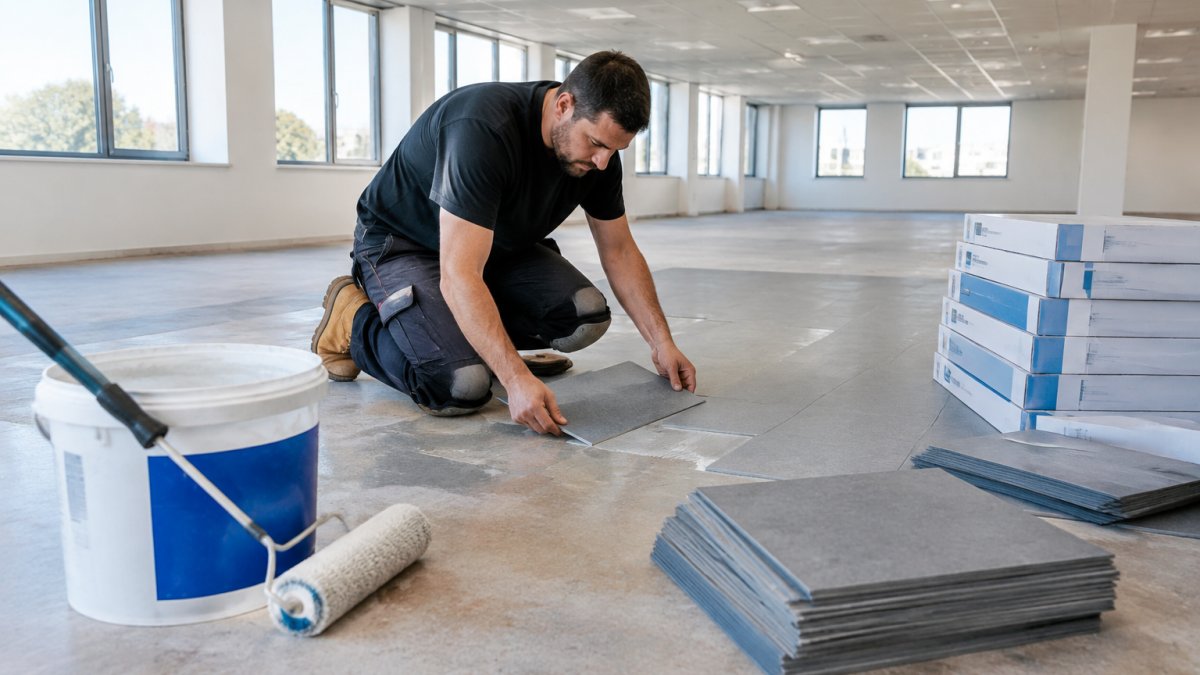
- Site survey and moisture testing. The fitter checks the subfloor for damp, contamination and level deviation, and records the results.
- Subfloor preparation. Old adhesive is removed, cracks are filled, and a levelling compound is applied where needed.
- Acclimatisation. Materials are left in the building so they settle to room temperature and humidity before fitting.
- Installation. Tiles, planks or sheet are laid to the agreed pattern, with expansion gaps and seams handled correctly.
- Finishing and handover. Trims, thresholds and skirting are fitted, the site is cleaned, and you receive documentation.
The Health and Safety Executive guidance on safe working practices applies to every stage, from manual handling of flooring rolls to the safe use of adhesives in occupied buildings.
Why Commercial Floor Preparation Decides the Finish
Commercial floor preparation is the single biggest factor in whether a floor looks good in year five, not week one.
Concrete subfloors hold moisture, and a floor laid over damp concrete will lift, bubble or discolour regardless of how good the material is. Old adhesive residue causes new adhesive to fail.
A proper preparation stage includes moisture testing, mechanical removal of old adhesive, crack repair, and smoothing compound applied to the correct thickness.
How Long Does a Flooring Installation Timeline Take?
A commercial flooring installation timeline typically runs from one to two weeks for a single open-plan floor, with larger multi-room projects taking longer. The exact duration depends on floor area, material, subfloor condition and how many hours per night the site is available.
For planning purposes, break the programme into stages:
| Stage | Typical Duration | What Affects It |
|---|---|---|
| Site survey and moisture testing | 1-2 hours | Access, number of rooms |
| Subfloor preparation | 1-3 days | Damp readings, old adhesive, levelling needed |
| Acclimatisation | 24-48 hours | Material type, building conditions |
| Installation | 1-5 days | Area, pattern complexity, material |
| Finishing and handover | Half a day | Trims, thresholds, snagging |
Out-of-hours working stretches the calendar but protects your operating day, and is a way of minimising disruption to the working day.
Office Carpet Tile Replacement Without Closing the Office
Office carpet tile replacement can be done without closing the office, provided the work is phased by zone and carried out overnight or at weekends.
A practical approach is to divide the floor into zones and work through them in phases, so that each area can be returned for use before staff arrive.
- Night one: zone A cleared, old tiles lifted, subfloor checked and prepared.
- Night two: zone A installed and finished; zone B cleared.
- Night three: zone B installed; zone C cleared.
- Continue until complete, with a final snagging walk on the last morning.
Watch out: if the existing tiles are glued down rather than loose-lay, removal takes longer and the programme needs to reflect it. Ask your fitter to confirm the fixing method during the survey, not on the first night.
What a Flooring Fitters Quote Should Itemise
A flooring fitters quote should list every cost separately, so you can see what you are paying for and compare like for like. A single lump sum hides the difference between a thorough job and a rushed one.
Ask for these lines, each with its own figure:
- Subfloor preparation, including moisture testing and levelling
- Materials, with brand, product name and quantity
- Adhesives and sundries
- Installation labour, with hours or days stated
- Out-of-hours or weekend working uplift
- Waste removal and disposal
- Trims, thresholds and skirting
- Contingency for unforeseen subfloor issues
Comparing quotes on the total alone is how facilities managers end up with rework. Two quotes for the same office can differ by thousands simply because one includes preparation and the other does not.
What actually moves the price
An itemised quote is only useful if you understand which lines are fixed and which flex with the site. In practice, the biggest swings come from four things.
Subfloor condition. A sound, dry, level screed needs a primer and little else.
Out-of-hours working. Overnight and weekend work carries an uplift, because labour rates are higher and supervision is harder.
Project size and phasing. A single open-plan floor is quicker per square metre than a multi-room fit with corridors, thresholds and phased handovers.
London-specific factors to check in the quote
Logistics in London affect the price in ways that are easy to miss until the invoice arrives. Check that the quote addresses these explicitly.
- Waste removal and disposal. Flooring waste is bulky and heavy. Ask whether disposal is included, whether the waste carrier is licensed, and whether you will receive a waste transfer note.
- Parking and loading. Ask how the fitter plans to load in and out, and whether any parking or loading bay costs are included. On restricted streets, this can add time and cost to every shift.
- Borough-level scheduling. Availability and access rules vary across boroughs, and some buildings have their own delivery windows and noise restrictions. A fitter who has worked in your building type before will plan around these.
- Building management requirements. Many commercial buildings require method statements, insurance certificates and operative inductions before work starts. Ask whether the fitter has allowed time for this, because it affects the start date, not the price.
- Material delivery and storage. Flooring needs to be stored flat, dry and at room temperature before fitting. If your building cannot provide secure storage, the fitter may need to deliver in phases, which affects both programme and cost.
Pricing depends on area, material, access and programme, so please request a quote for current prices. If you want to see the flooring categories we work with before you request a figure, you can browse our flooring products and categories.
Request a Quote for Your Commercial Flooring Project
The gap between a floor that lasts and one that fails is almost always decided before the first tile is laid: in the survey, the preparation and the paperwork. Get those right and the installation takes care of itself.
If you are weighing up flooring fitters for a commercial space, request a quote and we will be happy to discuss the scope of your project.
Get started with RW Flooring and request a quote for your commercial flooring project.
Frequently Asked Questions
How much do flooring fitters charge?
Commercial flooring fitters usually quote per project rather than per square metre, because the price depends on the material, the condition of the subfloor and whether work happens out of hours. A quote should separate labour, floor preparation, materials and waste removal so you can compare like for like. Ask for an itemised written quote and check what is excluded, such as moving furniture or making good skirting. Pricing varies by site, so request a quote for your own project rather than relying on generic figures.
How long does it take to fit flooring in an office?
The flooring installation timeline depends on the area, the material and the state of the subfloor. A single meeting room in carpet tiles can be finished in a day, while a full floor of LVT across a large office typically runs to several days once preparation and adhesive curing are counted. Moisture-tolerant screeds and levelling compounds need drying time before any finish goes down, and that waiting period often shapes the schedule more than the fitting itself. A site survey gives you a realistic programme.
Can commercial flooring be installed outside normal working hours?
Yes. Many commercial flooring fitters work evenings, weekends and overnight to keep offices, clinics and schools open during the day. Out-of-hours fitting usually carries a premium on labour, so confirm the rate before booking. Ask how noise, adhesive odour and access are managed, and agree a handover time so the space is usable when staff arrive. For healthcare and hospitality sites that run continuously, phased sections worked overnight are often the only practical route.
What preparation is needed before commercial flooring is installed?
Commercial floor preparation typically involves removing the old covering, checking the subfloor for moisture and flatness, filling cracks, grinding high spots and applying a primer or levelling compound. Skipping these steps is the most common cause of failures such as lifting seams, hollow sounds and tiles breaking at the joints. Ask your flooring fitters for moisture readings and a written method statement before work starts, and confirm who is responsible for making good the subfloor if problems appear.
Do flooring fitters remove and dispose of old flooring?
Most commercial contractors will strip and dispose of the existing floor as part of the quote, but it is rarely included by default, so confirm it in writing. Uplift of carpet tiles, vinyl or screed is charged separately because it takes time and skip space. Ask where waste goes and whether any of it is recycled. If your building has a waste carrier policy or a loading bay booking system, mention it early so removal does not delay the programme.
