
Last Updated: November 11, 2026
Quick Summary
The 5 best flooring options for schools are luxury vinyl tile for classrooms and corridors, sheet vinyl for labs and wet areas, carpet tiles for libraries, rubber flooring for sports halls and dining areas, and linoleum for general classrooms. We ranked them on durability, safety, acoustics, maintenance and whole-life cost.
- We weighted durability and whole-life cost most heavily when scoring each option.
- Sheet vinyl’s welded seams stop water reaching the subfloor in labs and clinics.
- Carpet tiles let you lift and replace a damaged square without closing the room.
- Skipping subfloor preparation is the most common cause of premature flooring failure.
- Confirm subfloor condition and moisture readings before ordering materials to avoid programme slippage.
Table of Contents
- How We Ranked the Five Best Flooring Options for Schools
- 1. Luxury Vinyl Tile: The Best Flooring for Classrooms and Corridors
- 2. School Vinyl Flooring: Sheet Vinyl for Labs, Clinics and Wet Areas
- 3. School Carpet Tiles: Acoustic Comfort for Classrooms and Libraries
- 4. Rubber Flooring: Impact Absorption for Sports Halls and Dining Areas
- 5. Linoleum: The Low-Impact Option for Classrooms
- School Flooring Maintenance and Whole-Life Cost
- Room-by-Room Recommendations and Inclusive Design
- Frequently Asked Questions
How We Ranked the Five Best Flooring Options for Schools
Choosing the 5 best flooring options for schools comes down to how each material performs under heavy daily use. This guide ranks exactly five options against shared criteria, so you can compare them fairly rather than by brochure claims. The stakes are high: flooring covers a large share of any school’s estate, and a poor specification means disruption, rework and premature replacement.
The Criteria That Decided the Ranking
Every option was scored on the same six points: durability and wear resistance under high foot traffic, slip resistance and safety, impact absorption and acoustic comfort, cleaning and maintenance demands, lifecycle cost, and suitability for specific rooms. We weighted durability and whole-life cost most heavily, because a floor that fails early costs far more than its purchase price. Installation disruption and subfloor preparation also counted, since schools rarely have the luxury of empty buildings.
For a deeper look at the durability case behind these criteria, see our guide to durable flooring in schools and its long-term value.
1. Luxury Vinyl Tile: The Best Flooring for Classrooms and Corridors
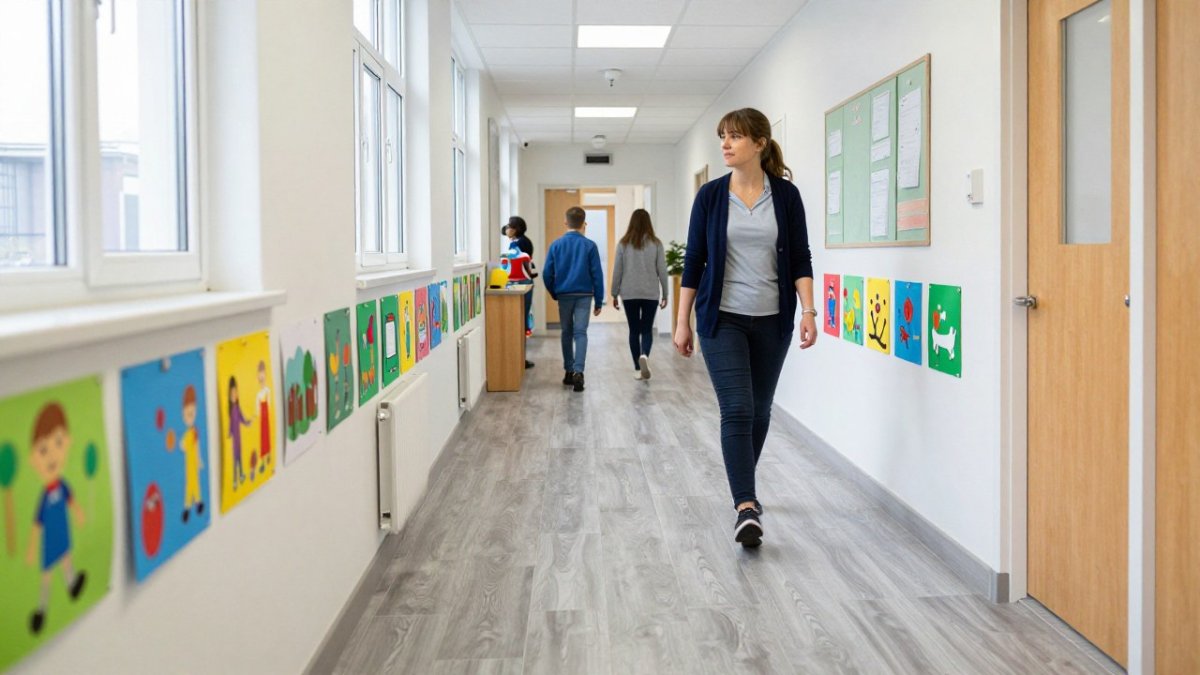
Luxury vinyl tile (LVT) takes the top spot because it balances wear resistance, design flexibility and comfort underfoot better than any other single material. Rigid core vinyl planks handle high foot traffic well, resist scuffs and stains, and come in wood and stone effects that lift corridors without the cost of engineered hardwood. Cleaning is straightforward: a damp mop and a neutral cleaner.
Pros and Cons of LVT in Schools
Pros: excellent wear resistance, easy cleaning, water resistance in most ranges, wide design choice, comfortable underfoot compared with tile.
Cons: quality varies sharply between ranges, so check the wear layer; heavy furniture can dent softer backing; some budget ranges look tired quickly.
Watch out: specifying on price alone often means a thin wear layer that scuffs within a term. Ask for the specification sheet, not the sample.
If you are weighing LVT against other non-slip surfaces for corridors, our comparison of non-slip flooring choices for schools sets them side by side.
2. School Vinyl Flooring: Sheet Vinyl for Labs, Clinics and Wet Areas
Sheet vinyl ranks second because nothing else matches it for seamless hygiene in wet and clinical spaces. School vinyl flooring comes in homogeneous and safety-backed variants, both of which resist water, stains and chemical spills far better than jointed materials. Science laboratories, clinics, food technology rooms and changing areas are its natural home.
Where Sheet Vinyl Wins and Where It Falls Short
Homogeneous sheet vinyl is one of the most durable options available for schools, and its welded seams stop water reaching the subfloor. The trade-offs: design choice is narrower than LVT, and heavy point loads can tear it if the subfloor is uneven.
For hygienic compliance in labs and clinics, our guide to durable flooring for hygienic compliance covers the specification checks that matter.
3. School Carpet Tiles: Acoustic Comfort for Classrooms and Libraries
School carpet tiles rank third, and they win on one criterion the hard materials cannot touch: noise reduction. Classrooms and libraries with carpet tiles feel calmer, and impact absorption reduces both footfall noise and the risk of slips. Modular tiles also mean a stained or damaged square can be lifted and replaced without closing the room.
Pros and Cons of Carpet Tiles
Pros: strong acoustic comfort, replaceable modules, warmer underfoot, good for reading areas and early years rooms.
Cons: harder to clean than vinyl, unsuitable for wet areas, and requires a disciplined maintenance regime.
If you are comparing carpet tiles against hard floors, our round-up of school corridor flooring alternatives to carpet shows what works elsewhere in the building.
4. Rubber Flooring: Impact Absorption for Sports Halls and Dining Areas
Rubber flooring ranks fourth overall but first for sports halls and dining areas. Its impact absorption suits activity spaces, and it handles heavy foot traffic. Pricing depends on quantity, dates and delivery, so request a quote from RW Flooring for current figures.
5. Linoleum: The Low-Impact Option for Classrooms
Linoleum closes the ranking. It is scratch-resistant and easy to clean, which suits general classrooms.
School Flooring Maintenance and Whole-Life Cost
School flooring maintenance is where budgets are won or lost, and whole-life cost is the single most useful comparison schools can make. Whole-life cost is often a better guide than the purchase price alone, once cleaning, repair and replacement are counted. Rather than comparing purchase price alone, build a simple whole-life cost model per square metre that adds four things: the supplied and installed cost, the annual cleaning and maintenance cost, the expected repair spend, and the replacement cost divided across the years the floor will realistically last.
How the Five Options Compare on Whole-Life Cost
The calculation is sensitive to two variables: how intensively the room is used, and how well the subfloor was prepared. A floor laid over a damp or uneven subfloor will fail early regardless of material, which is why subfloor preparation belongs in the whole-life model rather than in a separate contingency.
Planning Replacement Before You Specify
Replacement planning should start before you specify, not after. Phasing work by room, booking out-of-hours installation and confirming subfloor condition early can all help reduce disruption. A realistic replacement horizon helps: hard surfaces in corridors and halls typically outlast those in wet areas, and carpet tiles in libraries can be rotated and patched rather than replaced wholesale. For a practical walkthrough, read our guide on how to plan school flooring installation.
Watch out: skipping subfloor preparation is the most common cause of premature failure. Moisture and unevenness destroy good flooring fast, and the resulting replacement cost wipes out any saving made at specification stage.
Room-by-Room Recommendations and Inclusive Design
Match the material to the room, not the other way round, and treat the boundaries between rooms as part of the specification rather than an afterthought.
| Room | Recommended Option | Why It Fits |
|---|---|---|
| Classrooms and corridors | Luxury vinyl tile | Durable, easy to clean, design choice |
| Labs, clinics, wet areas | Sheet vinyl | Seamless hygiene, water resistance |
| Libraries and quiet rooms | Carpet tiles | Acoustic comfort, replaceable modules |
| Sports halls and dining | Rubber flooring | Impact absorption, heavy traffic |
| General classrooms | Linoleum | Sustainable, scratch-resistant |
Inclusive Design and Accessibility
Inclusive design matters at every threshold. Consistent slip resistance across a route, tonal contrast at floor transitions and level changes, and flush junctions between materials all support pupils and staff with visual impairments or mobility needs. Wheelchair users notice changes in surface height and rolling resistance far more than colour, so specify level transitions and avoid deep pile or loose-laid mats at doorways. Sensory comfort also counts: carpet tiles in quiet rooms reduce noise, while hard surfaces in corridors need acoustic treatment elsewhere to stop sound bouncing. Specifying these from the start is generally preferable to retrofitting them.
Installation Disruption and Refurbishment Logistics
A room-by-room plan only works if it survives the school timetable. Phase work by room and by term, keeping noisy or dusty preparation away from exam periods and quiet weeks. Confirm subfloor condition and moisture readings before materials are ordered, because drying or curing time for adhesives and screeds can add days to a programme. Out-of-hours and holiday installation reduces downtime but raises labour cost, so weigh that against the cost of closing a teaching space.
Watch out: ordering materials before the subfloor has been surveyed is the most common cause of programme slippage, because moisture and unevenness force either a delay or a premature failure.
The real challenge is not choosing a material but getting it fitted without disrupting teaching. RW Flooring brings over 15 years of experience to education projects, with out-of-hours fitting, complete subfloor preparation and safety methods maintained on every job. Get started with RW Flooring and specify school flooring that lasts, with dependable project delivery from first survey to final installation.
Frequently Asked Questions
What is the best flooring for a school?
There is no single answer because a school is several different buildings under one roof. Luxury vinyl tile suits classrooms and corridors where wear resistance matters most, sheet vinyl works in labs and wet areas, carpet tiles control noise in libraries, rubber flooring absorbs impact in sports halls, and linoleum offers a lower-impact option for general teaching spaces. The right choice depends on the room, the traffic it takes and the cleaning regime your site team can sustain.
Is school vinyl flooring suitable for corridors and wet areas?
Yes. School vinyl flooring covers both tile and sheet formats, and both handle heavy foot traffic well. Homogeneous sheet vinyl is the stronger choice for science laboratories, clinics and washrooms because seams can be welded to create a continuous surface that resists water and spills. In corridors, luxury vinyl tile gives similar performance with faster replacement of individual damaged tiles, which matters when a section wears out long before the rest of the floor.
Are school carpet tiles a good choice for classrooms?
They can be, particularly where noise is a problem. Modular carpet tiles absorb sound, which helps in classrooms, libraries and music rooms, and a damaged tile can be lifted and replaced without touching the surrounding floor. The trade-off is cleaning: carpet needs regular vacuuming and periodic deep cleaning, and it is a poor fit for dining areas, art rooms or anywhere spills are routine. Specify a tight-loop, stain-resistant tile for education use.
Which school flooring is easiest to clean and maintain?
Sheet vinyl and luxury vinyl tile are the simplest to keep clean. Both take a damp mop, resist stains and do not trap dust, which helps where indoor air quality is a concern. Linoleum is also straightforward and described as scratch-resistant and easy to clean. Carpet tiles need vacuuming and periodic extraction, so budget for the labour as well as the material. Whatever you choose, school flooring maintenance costs depend more on the cleaning schedule than on the surface itself.
How do you choose flooring for different areas of a school?
Match the floor to what happens in the room. Corridors and general classrooms need wear resistance and slip resistance, so luxury vinyl tile is a sensible default. Labs, clinics and washrooms need water resistance and a seamless surface, which points to sheet vinyl. Sports halls and dining areas need impact absorption, so rubber flooring earns its place. Libraries and quiet rooms benefit from carpet tiles. Plan the whole site together so maintenance, replacement cycles and accessibility are consistent.
