

Quick Summary
Hotel flooring suppliers in the UK fall into three groups: manufacturers with their own ranges, distributors stocking several brands, and full-service contractors offering supply and fitting together. Compare each on published technical data, lead times, installation capacity and warranty terms, and ask every supplier for the same written brief so quotes can be compared fairly.
- Ask every supplier who manufactures the product, who fits it, and who responds if it fails in year three.
- Request a physical sample and a datasheet showing wear classification, slip resistance and fire performance.
- Get lead times and warranty terms in writing for the specific product, not generic ranges.
- Ask for subfloor preparation and removal costs to be shown separately in each quote.
- Divide total installed cost by expected years of service, then add annual cleaning cost to compare lifecycle cost.
Table of Contents
- How UK Hotel Flooring Suppliers Differ
- Side-by-Side Comparison of Five Hotel Flooring Suppliers
- Hotel Carpet Tiles, Vinyl and Hard Flooring: Which Suits Which Space
- Flooring for High-Traffic Hotel Areas and Wet Zones
- Hotel Vinyl Flooring: Performance, Cleaning and Lifecycle Cost
- Planning a Hotel Flooring Installation Around Live Trading
- Requesting Quotes From Your Shortlist With RW Flooring
- Frequently Asked Questions
How UK Hotel Flooring Suppliers Differ
Last Updated: November 1, 2026
Hotel flooring suppliers in the UK fall into three groups: manufacturers with their own ranges, distributors stocking several brands, and firms offering supply and fitting as one contract. Knowing which type you are dealing with saves weeks of back-and-forth later.
Manufacturers publish the widest technical data, including wear ratings, slip resistance and fire classifications. Distributors compete on price and lead time. Full-service contractors carry the most risk but the least coordination work for your team.
Ask every supplier the same three questions: who manufactures the product, who fits it, and who answers if something fails in year three. Vague answers to any of these are a warning sign.
Side-by-Side Comparison of Five Hotel Flooring Suppliers
We compared five suppliers that appear regularly in UK hotel flooring searches. Pricing is quote-based for all of them, so the table focuses on what each one publishes, and on the criteria that decide whether a supplier suits your project.
| Supplier | Core Offer | Installation | Published Price | Warranty (as published) | Lead Time (typical) | Service Coverage | Best For |
|---|---|---|---|---|---|---|---|
| RW Flooring | Commercial flooring fitting, subfloor prep to finish | Yes, including out-of-hours work | Quote only | Not stated publicly, request in writing | Programme-dependent; confirm per project | National, with out-of-hours scheduling | Projects needing minimal daytime disruption |
| Impervia Hotel Flooring | Hotel-focused flooring range | Not specified | Contact for pricing | Not stated publicly | Not stated publicly | Not stated publicly | Buyers wanting sound-reducing, sustainable options |
| Junckers Hotel Flooring | Solid hardwood for hotel interiors | Not specified | Contact for pricing | Not stated publicly | Not stated publicly | Not stated publicly | Hotels wanting wood with high-traffic durability |
| Meadee Flooring | Supply and installation for hotels | Yes | Contact for pricing | Not stated publicly | Not stated publicly | Not stated publicly | Teams wanting one contractor for both supply and fitting |
| Hotel Designs Directory | Directory of hotel flooring suppliers | Not applicable | Not stated | Not applicable | Not applicable | Not applicable | Shortlisting wood, LVT and hard-flooring suppliers |
RW Flooring is a specialist commercial contractor with over 15 years of experience across workplaces, healthcare, education and hospitality.
Impervia presents FloorScore certification and sound reduction as selling points, which matter in busy corridors and function rooms.
Junckers focuses on solid hardwood, which suits lobbies and restaurants where appearance counts.
Meadee states that it both supplies and installs, with hotel experience including IHG properties.
Hotel Designs is a directory rather than a supplier.
How to Assess a Supplier Before You Shortlist
A comparison table only gets you so far. Use this checklist for every company on your longlist:
- Samples and technical data. Ask for a physical sample plus the datasheet showing wear classification, slip resistance, fire performance and cleaning recommendations. A supplier who cannot produce these quickly is unlikely to produce them after an order.
- References. Request two or three hotel references of similar size and traffic profile, and ask how the supplier handled snagging and aftercare.
- Installation capacity. Confirm whether fitters are directly employed or subcontracted, how many crews are available, and whether out-of-hours work is standard or an exception.
- Lead times. Get lead times in writing for the specific product, not a generic range. Imported ranges can carry longer lead times than stocked lines, affecting your phasing plan.
- Warranty and aftercare. Ask what the warranty covers, how long it runs, what voids it (including cleaning chemicals), and who responds if a seam or edge fails in year three.
Supply-Only Versus Supply and Installation
Supply-only purchasing looks cheaper on the first invoice. The gap usually closes once you add subfloor work, fitting labour, waste removal and the cost of managing two contractors.
Supply and installation puts one party responsible for the finished floor. If an edge lifts or a seam fails, there is one name to call. For most hotel refurbishments with tight programmes, that single point of accountability is worth paying for.
What Drives the Price Beyond the Product
Quote-based pricing makes comparison hard, so ask each supplier to break the quote into the same lines. The main cost drivers are:
- Supply. Product choice, range and whether the line is stocked or imported.
- Subfloor preparation. Levelling, moisture control and repair can add significant cost, especially in older buildings.
- Installation. Labour rates, access, out-of-hours premiums and the number of rooms in the programme.
- Removal and disposal. Lifting and disposing of the existing floor, including any asbestos survey where building age requires it.
- Maintenance and replacement. Cleaning regime, refinishing intervals and the cost of replacing worn areas early.
A quote that separates these lines is easier to compare and harder to inflate later. Ask for the subfloor preparation and removal costs to be shown separately, even if the supplier prefers a single figure.
Hotel Carpet Tiles, Vinyl and Hard Flooring: Which Suits Which Space
Each flooring type handles a different set of demands.
Vinyl offers a strong balance of durability and cleaning. Many products carry low-emission credentials and are compatible with recyclable underlays, which can help with sustainability targets.
Hardwood flooring gives the most premium finish. It is the most expensive to install and needs careful maintenance, but it can be sanded and refinished when worn.
Flooring for High-Traffic Hotel Areas and Wet Zones
Entrances, lobbies, corridors and restaurant floors take the heaviest wear. Choose a product with a high commercial wear rating and a surface that holds up to grit and frequent mopping.
Wet areas need a different specification. Spas, gyms, changing rooms and pool surrounds require slip-resistant surfaces that stay safe when damp. Confirm the slip rating with the supplier and ask how the floor performs with the chemicals your housekeeping team actually uses.
Translating Technical Ratings Into Hotel Specifications
Most suppliers publish technical data, but the numbers only help if you know what they mean for a hotel. Use the following as a guide when comparing products, and ask the supplier to confirm the rating for the specific product and colour you are ordering.
- Wear classification. Commercial wear ratings indicate how well a floor resists abrasion under traffic. For hotel corridors and lobbies, look for a product rated for heavy commercial use rather than light domestic or light commercial. Ask the supplier to state the classification on the datasheet, not just in the brochure.
- Slip resistance. Slip ratings are measured under different conditions, dry, wet and sometimes with contaminants such as oil or soap. For pool surrounds, spas and changing rooms, ask for the wet slip rating specifically and confirm the test method. A product that passes a dry test can still be unsuitable for a wet zone.
- Fire performance. Hotel floors in escape routes and corridors need to meet fire performance requirements. Ask for the fire classification and confirm it suits the area you are flooring, particularly corridors and stairwells.
- Acoustic performance. In bedrooms and corridors, impact sound matters. Ask for acoustic test data if sound reduction is a selling point, and check whether the figure applies to the product alone or the full build-up including underlay.
- Cleaning compatibility. Confirm which cleaning chemicals and methods the warranty assumes. A floor that performs well under one cleaning regime can fail under another, and using the wrong product can void the warranty.
A floor that looks right in a showroom can become slippery once it is in service. Ask for test data or a sample to be walked on under real wet conditions before ordering the full area, and test it with the cleaning chemicals your housekeeping team actually uses.
Matching the Floor to the Space
Different hotel areas put different demands on the floor, and the specification should follow the space rather than a single product across the whole property.
- Entrances and lobbies. High wear, grit and moisture. Use entrance matting and a hard or resilient floor with a high wear rating and a surface that tolerates frequent cleaning.
- Corridors. Acoustic comfort and wear resistance both matter. Carpet tiles with a dense pile work well, provided they are specified for heavy commercial use and cleaned on a regular deep-clean cycle.
- Bedrooms. Comfort and acoustic performance usually outweigh wear resistance. Carpet or carpet tiles allow individual replacement after stains.
- Restaurants and bars. Spills, chairs and footfall. A resilient floor with good slip resistance and easy cleaning is usually the practical choice.
- Spas, gyms and changing rooms. Wet slip resistance is the priority, along with resistance to cleaning chemicals and hygiene requirements.
A Practical Specification Checklist
Before you order, confirm the following for each product and area:
- Wear classification suitable for the traffic level of the space.
- Wet slip rating for wet zones, with the test method stated.
- Fire classification suitable for corridors and escape routes.
- Acoustic data if sound reduction is claimed, including the full build-up.
- Cleaning chemicals and methods compatible with the warranty.
A supplier who can answer these questions in writing is easier to hold to account later, and the answers make side-by-side comparison of products far more meaningful than a showroom sample alone.
Hotel Vinyl Flooring: Performance, Cleaning and Lifecycle Cost
The purchase price is the smallest part of a flooring cost over its life.
Ask suppliers for the expected wear life under your expected traffic, the cleaning method they recommend, and what happens to warranty cover if a housekeeping contractor uses a different product.
Plan a simple cost comparison before you decide. Divide the total installed cost by the years you expect the floor to last, then add annual cleaning cost.
Planning a Hotel Flooring Installation Around Live Trading
A hotel rarely closes for a refurbishment. Floors are usually replaced in phases, room by room or floor by floor, while guests are still in the building.
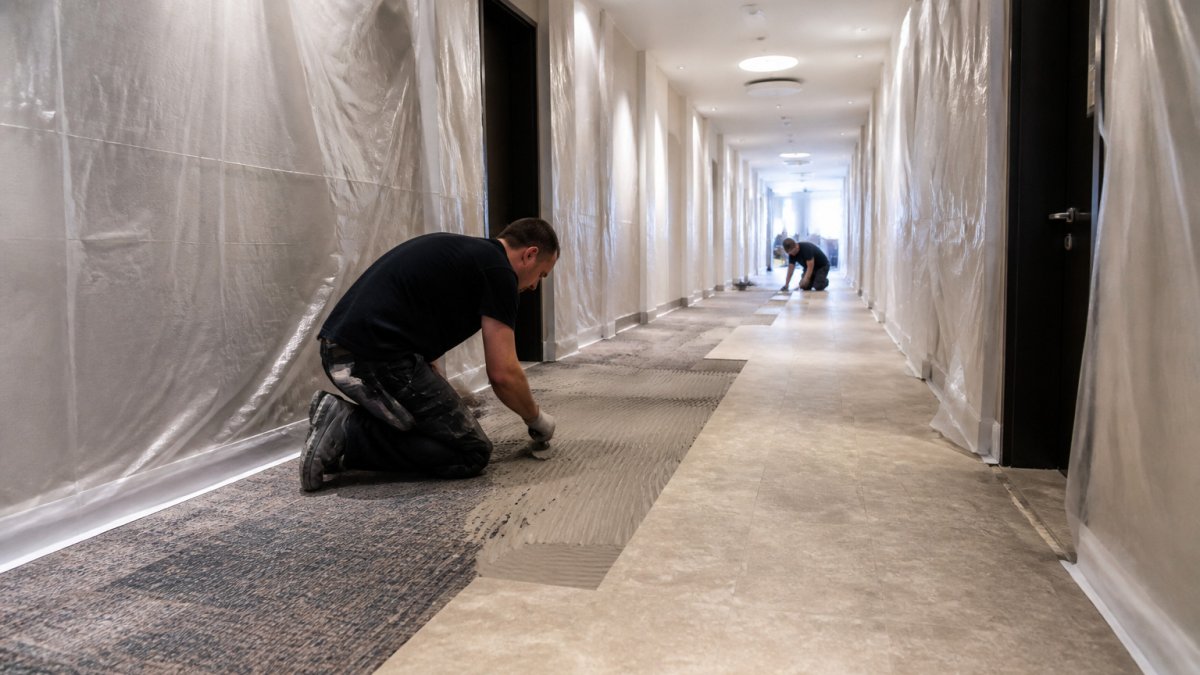
Agree a fitting window for each area, reserve storage for furniture, and set up dust and noise controls with protective sheeting along corridors.
Agree how the contractor will handle access, deliveries and emergencies during the programme. A written plan protects both the hotel and the fitter when schedules shift.
Requesting Quotes From Your Shortlist With RW Flooring
Send every shortlisted supplier the same brief: floor areas, space types, expected traffic, any wet zones, required slip and fire ratings, and your programme dates. Quotes built from identical information are the only ones you can compare fairly.
RW Flooring fits out-of-hours where trading must continue. Ask for the quote to show subfloor preparation separately, along with what is included in the finish and any exclusions.
Frequently Asked Questions
What is the best flooring for a hotel?
There is no single best option. Carpet tiles suit bedrooms and corridors where acoustic comfort and easy replacement of single tiles matter. Vinyl and luxury vinyl tile suit wet areas, breakfast rooms and back-of-house spaces because they resist moisture and clean quickly. Solid hardwood suits lobbies and restaurants where appearance matters and traffic is moderate. Match the material to the wear, moisture and cleaning demands of each space, and ask suppliers for their wear and slip-resistance data before deciding. Pricing depends on quantity, dates and delivery, so request a quote from RW Flooring for current figures.
What should I compare when getting hotel flooring quotes?
Compare what each quote includes: subfloor preparation, underlay, adhesives, edge trims, waste allowance, removal of existing floor coverings and disposal. Check whether installation is included or the supplier only provides materials. Ask about working hours, since out-of-hours fitting can avoid disrupting guests but may cost more. Request product specifications covering wear resistance, slip rating and warranty terms, and ask for references from completed hotel projects. A lower headline price can hide gaps in preparation or aftercare, so compare quotes line by line rather than by total alone.
How can hotels minimise disruption during flooring installation?
Phase the work by floor or wing so that rooms can stay in use, and schedule noisy stages such as removing old flooring for quiet periods. Agree access routes, dust control and protected areas before work starts. RW Flooring offers out-of-hours fitting, which can help limit disruption to the working day. Ask any supplier how they will manage mid-project problems and how quickly they respond.
