
Last Updated: November 4, 2026
Quick Summary
The main school corridor flooring alternatives to carpet are luxury vinyl tile, sheet vinyl, rubber, linoleum and safety flooring, with entrance matting as the first line of defence. Vinyl suits general corridors, rubber helps where noise is the problem, and safety flooring belongs at entrances, ramps and wet zones.
- Insist on a commercial-grade wear layer rated for high-traffic areas when specifying vinyl.
- Safety flooring belongs at entrances, ramps and any corridor that gets wet.
- Rubber absorbs footfall and reduces impact sound travelling into adjacent classrooms.
- Specify low VOC emissions and ask for documented low-emission certification for the specific product.
- The installation sequence is moisture testing, subfloor preparation, levelling compound, then installation.
Table of Contents
- Why Carpet Falls Short in School Corridors
- The Main School Corridor Flooring Alternatives Compared
- Slip Resistant Flooring for Schools: Safety Standards and Slip Coefficients
- Acoustic Performance, Indoor Air Quality and Sensory Considerations
- School Flooring Maintenance Costs and Cleaning Protocols
- Installation Time for School Flooring and Subfloor Preparation
- Lifecycle Costs, Durability and Environmental Impact
- Choosing the Right Corridor Flooring for Your School
- Frequently Asked Questions
Why Carpet Falls Short in School Corridors
Carpet in a school corridor is a maintenance liability dressed up as comfort. Corridors are circulation zones, not classrooms: hundreds of pairs of shoes cross them every hour, often carrying grit, water and mud from entrance matting that was never specified properly. Tired carpet in education buildings tends to fail in a predictable way. It starts at the doorway, where a dirt barrier should be, and spreads outward as fibres flatten and stains set.
The problems compound. Carpet holds moisture after spills and wet weather, which feeds odour and mould risk. It traps dust and allergens, which matters for indoor air quality in a building full of children. And it wears unevenly, so a corridor that looks acceptable in September looks threadbare by the following summer.
The real argument against carpet, though, is lifecycle cost. A cheap carpet that needs replacing every few years costs more in disruption and labour than a resilient floor that lasts a decade. Below, we compare the main school corridor flooring alternatives to carpet, with the trade-offs that actually decide the specification.
The Main School Corridor Flooring Alternatives Compared
Several material families cover most corridor specifications. Each behaves differently under heavy-duty traffic, and the right choice depends on where the corridor sits in the building.
| Option | Best For | Key Strength | Main Trade-off |
|---|---|---|---|
| Luxury vinyl tile | General corridors, design-led schemes | Aesthetic versatility, easy cleaning | Wear layer quality varies widely |
| Sheet vinyl | Wet or heavily soiled routes | Seamless, hygienic surface | Subfloor must be very smooth |
| Rubber | Acoustic-critical corridors | Impact sound reduction, durability | Higher upfront material cost |
| Linoleum | Sustainability-led projects | Natural materials, low VOC emissions | Needs sealing and careful maintenance |
| Safety flooring | Ramps, entrances, wet zones | Slip resistance under contamination | Can feel harder underfoot |
Vinyl and Luxury Vinyl Tile
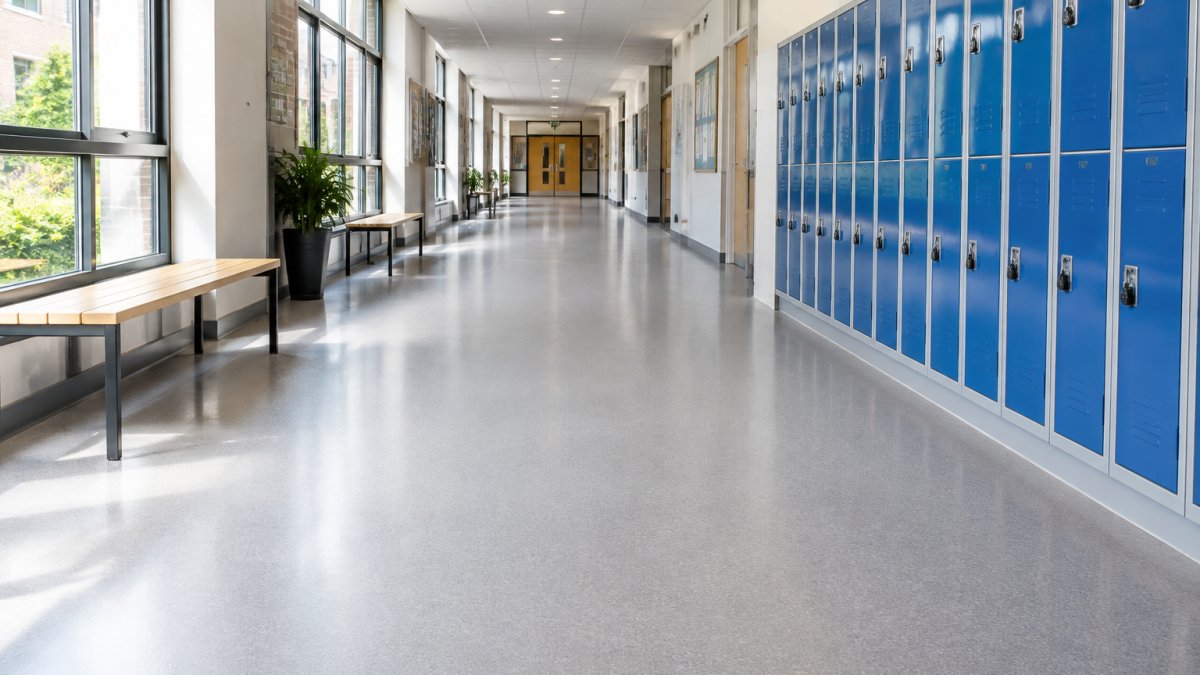
Vinyl is the default commercial grade answer for school corridors, and for good reason. Sheet vinyl gives a seamless surface that resists dirt and wipes clean, while luxury vinyl tile (LVT) adds design flexibility with plank and tile formats. The specification detail that matters is the wear layer, so insist on a commercial-grade product rated for high-traffic areas. Watch out: LVT installed over a poorly prepared subfloor telegraphs every ridge and hollow, so subfloor preparation is not optional.
Rubber and Linoleum
Rubber flooring can help where noise is the problem, as its acoustic properties absorb footfall. Linoleum, made largely from natural materials, suits sustainability-led briefs and carries lower VOC emissions than many synthetic options. Both are durable, but linoleum needs a maintenance regime that includes periodic sealing, and rubber costs more upfront than vinyl.
Safety Flooring and Entrance Matting
Safety flooring belongs at the points where slips actually happen: entrances, ramps and any corridor that gets wet. Entrance matting is the first line of defence, a dirt barrier that stops grit reaching the main floor.
Slip Resistant Flooring for Schools: Safety Standards and Slip Coefficients
Slip resistant flooring for schools is specified by its slip coefficient, measured under both dry and wet conditions. The key point is that slip resistance is tested wet as well as dry, because contamination is what causes most corridor falls.
In practice, entrance zones, ramps and any area exposed to weather need a higher rating than a dry internal corridor. Ask suppliers for test data on the specific product, not the product family.
Fire safety compliance is also essential. Flooring in education buildings must meet the relevant fire performance requirements, so confirm the classification before ordering.
Acoustic Performance, Indoor Air Quality and Sensory Considerations
Acoustic performance is where hard flooring is often criticised. Hard surfaces reflect sound, so corridors become noisy, and impact sound travels through the floor structure into adjacent classrooms. The fix is not to return to carpet but to design for sound. Rubber flooring absorbs footfall and reduces impact sound, acoustic underlays decouple the floor from the structure, and wall-mounted absorbers and ceiling rafts deal with the airborne noise that flooring alone cannot. Reverberation time is the metric that matters in a corridor: a highly reflective, echoing space is unpleasant for everyone and genuinely distressing for some pupils.
Indoor air quality matters just as much, and it is the factor most guides overlook in favour of aesthetics and durability. Flooring contributes to IAQ through volatile organic compound (VOC) emissions, particularly in the first weeks after installation. Low VOC emissions should be a specification requirement, especially in buildings with young children, and you should ask for documented low-emission certification for the specific product rather than the product family. Adhesives and levelling compounds matter as much as the floor covering itself, so specify low-emission systems across the whole build-up.
Sensory considerations for neurodivergent students are also worth planning for. A highly reflective, echoing corridor is genuinely distressing for some pupils, and the flooring choice is part of the solution. Matt finishes reduce glare, quieter underfoot materials reduce the sensory load of footfall, and consistent colour zoning helps wayfinding without visual clutter. Tactile contrast at stair edges and doorways supports pupils who rely on touch cues, and it should be designed in rather than added later.
Check the emissions of the whole system, including adhesives, not just the wear layer.
School Flooring Maintenance Costs and Cleaning Protocols
School flooring maintenance costs are driven by two things: how often the floor needs cleaning, and how long it lasts before replacement. A sealed, seamless floor needs routine mopping and periodic buffing. Safety flooring needs a more aggressive cleaning protocol because aggregate traps dirt. Carpet, by contrast, needs vacuuming daily and deep cleaning regularly.
The maintenance regime should be written into the specification. Ask three questions: what daily cleaning does it need, what periodic treatment does it need, and what voids the warranty? Hygiene standards in education settings mean spills must be cleanable, not just blotted.
Floor maintenance is where cheap specifications quietly fail. A floor that needs specialist cleaning products costs more to run than its purchase price suggests.
Installation Time for School Flooring and Subfloor Preparation
Installation time for school flooring depends almost entirely on subfloor preparation. A sound, level subfloor can be covered quickly. A failed screed or damp subfloor adds days before a single tile goes down.
The sequence is fixed: moisture testing, subfloor preparation, levelling compound, then installation. Skipping moisture testing is how contractors end up with lifting vinyl months later.
Out-of-hours fitting is one practical answer for occupied buildings. At RW Flooring, out-of-hours fitting is available, with minimal disruption to the working day and safety methods maintained on every project.
Lifecycle Costs, Durability and Environmental Impact
Lifecycle costs tell a different story from purchase price, and the difference is large enough to change a specification. A resilient floor with a commercial wear layer can outlast carpet, and carpet replacement can bring removal costs and disruption that do not always appear on the original quote. Total cost of ownership favours durability, but only if you model it properly rather than comparing headline prices.
The mechanism is straightforward. A total cost of ownership (TCO) calculation for a corridor floor has four components: the supply and installation cost, the routine cleaning cost over the service life, the periodic maintenance cost (sealing, buffing, deep cleaning), and the end-of-life cost of removal and disposal. Carpet scores badly on the last three. It needs daily vacuuming, regular deep cleaning, and replacement every few years in a busy corridor, and each replacement means stripping out bulky material that is difficult to recycle. A commercial-grade vinyl or rubber floor carries a higher supply cost but a far lower cleaning and replacement burden across a decade.
Durability comes down to three variables: wear layer thickness, subfloor quality and installation method. A well-installed vinyl floor in a high-traffic area holds up for years; a poorly installed one fails at the seams first. The wear layer is an important factor in corridor life, alongside subfloor quality and installation method.
Environmental impact extends beyond manufacture, and this is where most guides stop short. Disposal matters. Carpet is bulky and can be difficult to recycle, and disposal charges can rise over time. Vinyl and rubber can sometimes be recycled through specialist routes, and some manufacturers operate take-back schemes. Linoleum’s natural content helps at end of life, though its need for periodic sealing adds to the maintenance burden. Consider recyclable products, ask about take-back schemes, and factor disposal into the total cost of ownership.
Watch out: a cheap quote that ignores removal, disposal and downtime is not a cheaper floor, it is a deferred cost that lands on the school budget a few years later.
Choosing the Right Corridor Flooring for Your School
Start with the corridor’s job. Entrance and wet zones often suit safety flooring and entrance matting. Acoustic-critical routes can suit rubber. General corridors often suit commercial-grade vinyl or LVT. Sustainability-led briefs may point to linoleum.
Then weight the decision by lifecycle costs, not headline price. Choosing a contractor who preps the subfloor properly can reduce long-term costs compared with a cheap quote.
Frequently Asked Questions
What is the most durable flooring for school corridors?
Heavy-duty vinyl and commercial-grade rubber are the most durable options for school corridors. Look for a suitably thick commercial-grade wear layer for vinyl, rather than a domestic-grade product. Both handle high-traffic areas, trolley traffic and frequent cleaning without showing wear. Durability also depends on correct subfloor preparation and a maintenance regime that removes grit before it acts like sandpaper on the surface.
Is vinyl flooring better than carpet for schools?
For corridors, vinyl usually wins. It is easier to clean, does not trap dust or allergens, and stands up to constant footfall and spillages. Carpet still has a place in classrooms and quiet areas where impact sound reduction matters. Many schools choose a hybrid approach: slip resistant flooring for schools in circulation zones and carpet in teaching spaces. The right choice depends on noise, budget and cleaning capacity.
How does slip resistance impact school flooring choices?
Slip resistance is a safety requirement, not a nice-to-have. Flooring in schools should carry an appropriate slip resistance rating for the area, with higher ratings for entrance zones that get wet. Specify safety flooring with a textured surface in circulation zones and install entrance matting to stop dirt and moisture travelling down the corridor. Always ask for test certification before signing off a product.
What are the maintenance requirements for school corridor flooring?
Most hard corridor flooring needs daily damp mopping or auto-scrubbing, spot cleaning for spills, and periodic deeper cleaning or buffing depending on the product. Entrance matting reduces how often you clean. Hard corridor flooring can reduce some maintenance tasks compared with carpet, as it generally avoids deep extraction cleaning. Ask for a written cleaning protocol from your contractor so site staff use the right products.
Corridor flooring decisions are rarely urgent until a floor fails, and then they are urgent indeed. If you are weighing up school corridor flooring alternatives to carpet, get the specification and installation right the first time. RW Flooring brings over 15 years of experience, complete solutions from subfloor preparation to final installation, and out-of-hours fitting that keeps your corridors running. Request a quote and get a dependable, durable installation delivered on schedule.
