
Last Updated: November 13, 2026
Quick Summary
To learn how to choose flooring for a school, map each room by its use first, then match materials to those demands: vinyl for corridors, dining and labs, carpet tiles for classrooms, and rubber for halls and gyms. Check slip ratings, fire performance and cleanability, and judge options on whole-life cost rather than the quote price.
- Vinyl handles heavy traffic and wipes clean, but the subfloor must be smooth.
- Carpet tiles cut echo in classrooms; specify low-pile, tight-loop tiles for daily vacuuming.
- Rubber costs more upfront but absorbs impact and sound in sports halls.
- A cheap floor replaced in five years costs more than one lasting fifteen.
- Skipping subfloor preparation is the mistake that shortens corridor floor life most.
Table of Contents
- Start With How Each Space Is Used
- School Flooring Options Compared
- Choosing Classroom Flooring for Acoustics and Comfort
- School Corridor Flooring That Survives Peak Traffic
- Safety, Hygiene and Compliance Checks
- School Flooring Maintenance and Whole-Life Cost
- Common Mistakes to Avoid When Specifying School Floors
- Planning Your Installation With RW Flooring
- Frequently Asked Questions
Start With How Each Space Is Used
Learning how to choose flooring for a school starts with one question: what actually happens in each room? A dining hall, a science lab and a Year 2 classroom put very different demands on a floor. Projects that go wrong almost always skip this step.
School flooring is not one product. It is a set of decisions made room by room, based on traffic, noise, moisture and cleaning.
So map the building before you look at a single sample:
- Classrooms: comfort underfoot, low noise, easy cleaning
- Corridors: heavy footfall, trolleys, scuffing
- Halls and dining areas: spillages, chairs dragged daily
- Wet areas and labs: water, chemicals, slip risk
- Entrances: grit, mud and weather
Write it down as a simple table of room, use and priority. That document will guide every choice that follows.
School Flooring Options Compared
No single material suits every room, so compare school flooring options against the job each one does best. Here is how the main choices stack up.
| Material | Best For | Watch Out For |
|---|---|---|
| Vinyl (sheet or tile) | Corridors, dining, labs | Subfloor must be smooth |
| Carpet tiles | Classrooms, quiet zones | Hard to clean in wet areas |
| Rubber | Gyms, halls, heavy traffic | Higher upfront cost |
| Linoleum | Eco-focused projects | Needs sealing and care |
| Entrance matting | Main doors | Must be cleaned often |
Vinyl is widely used in education buildings. It handles heavy traffic, wipes clean and comes in slip-resistant grades. Carpet tiles suit classrooms where noise control matters, and individual tiles can be swapped when damaged.
Rubber costs more but absorbs impact and sound in sports halls. Linoleum works well where sustainability is a priority, though it needs proper sealing. Entrance matting stops dirt at the door before it reaches the corridors.
Choosing Classroom Flooring for Acoustics and Comfort
Classroom flooring has to do two jobs at once: keep noise down and stay comfortable for children sitting on the floor. Hard surfaces bounce sound around a room, which makes teaching harder. Soft surfaces absorb it.
Carpet tiles are the usual pick for classrooms. They cut echo, feel warmer underfoot and soften falls. The trade-off is cleaning, so specify a low-pile, tight-loop tile that holds up to daily vacuuming.
For art rooms, food technology and any space with water, vinyl is the safer call. A common mistake is carpeting a room with sinks. It never ends well.
Think about underfoot comfort too. Young children spend a lot of time on the floor, so a floor with some give reduces fatigue and minor injuries.
School Corridor Flooring That Survives Peak Traffic
School corridor flooring takes more punishment than any other surface in the building. Hundreds of pairs of shoes, bags dragged along walls and cleaning machines every night add up fast. Vinyl sheet flooring is often recommended here, because seams are the first thing to fail. Readers weighing up corridor surfaces can also explore school corridor flooring alternatives to carpet in depth.
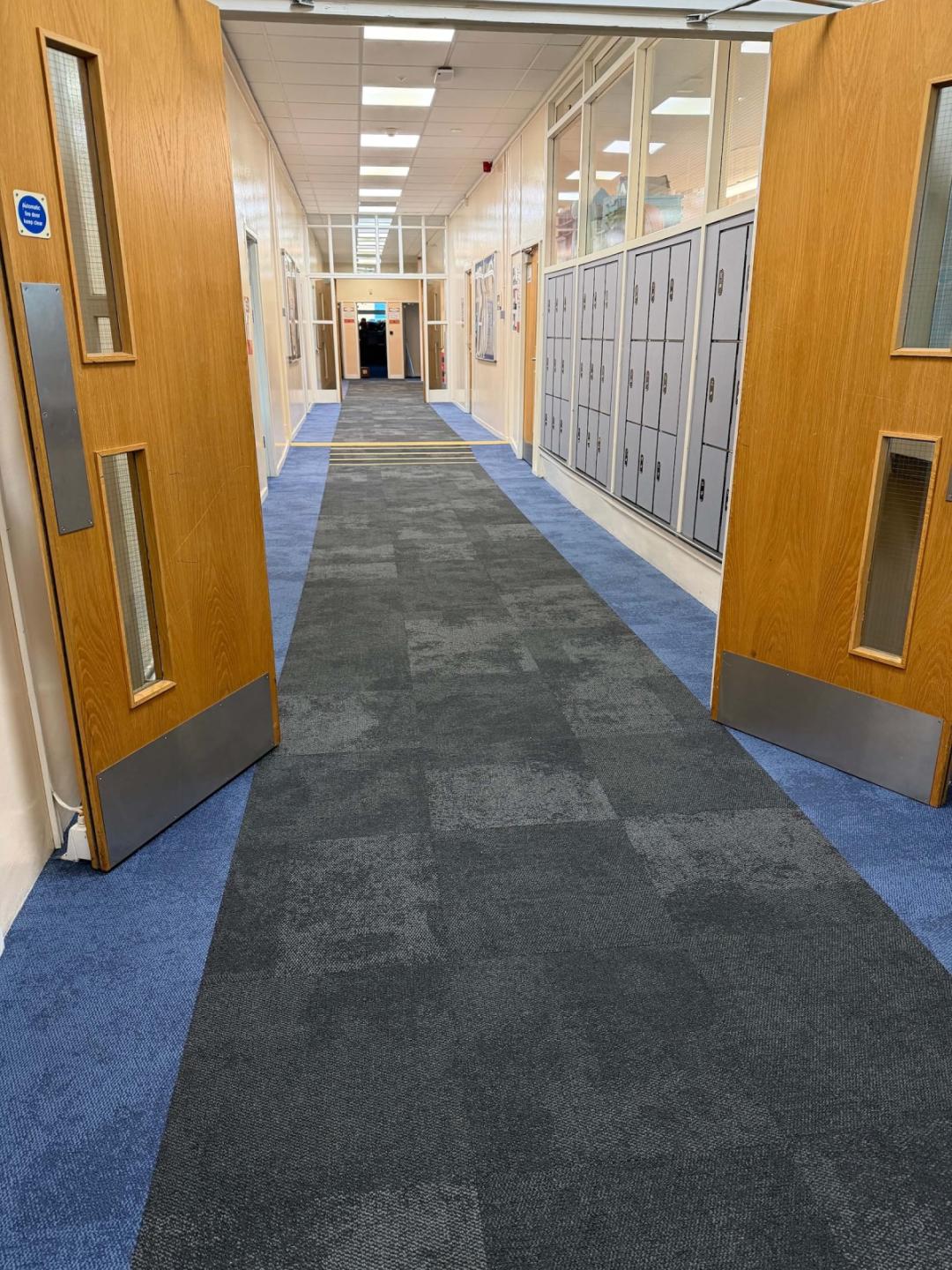
Where a corridor is long and narrow, sheet vinyl gives a continuous surface with few joints. Fewer joints mean fewer places for dirt and water to get in. If the budget is tighter, vinyl tiles work, but expect more maintenance over time.
Watch out: skipping the subfloor preparation is the mistake that shortens corridor floor life most. A floor laid over an uneven base will lift and crack within a few terms.
Safety, Hygiene and Compliance Checks
Safety and hygiene are not optional extras in a school. Slip resistance matters most in wet areas, entrances and dining halls. Ask for the slip rating of any product before it goes on the specification.
Fire performance also needs checking. Flooring in escape routes should meet the relevant safety standards, and your supplier should be asked to provide the test documentation.
Hygiene comes down to cleanability. Vinyl with welded seams and a coved skirting creates a surface that wipes clean with no gaps for dirt. This matters in food areas and toilets.
- Slip rating confirmed for wet areas
- Fire performance documents supplied
- Cleanability checked with the cleaning team
- Seams welded and edges sealed
A comparison of non-slip flooring choices for schools helps you match the right product to each risk area.
School Flooring Maintenance and Whole-Life Cost
School flooring maintenance decides the real cost of a floor, not the price on the quote. A cheap floor that needs replacing in five years costs more than a better one that lasts fifteen. That is whole-life cost, and it should sit at the heart of your decision.
Cleaning is the biggest ongoing cost. Smooth vinyl typically needs a daily mop and periodic machine clean. Carpet typically needs vacuuming and occasional deep cleaning. Entrance matting needs regular washing to stay effective.
Ask two questions of every option: how will it be cleaned, and who does it? If the answer does not fit your cleaning team’s routine, the floor will suffer. Our guide to durable flooring in schools and its long-term value breaks down these costs in more detail.
Common Mistakes to Avoid When Specifying School Floors
The same errors show up on school projects again and again. Avoiding them saves money and disruption.
- Skipping subfloor checks. Moisture and unevenness cause most failures.
- Choosing on price alone. The cheapest quote often hides thin materials.
- Ignoring the cleaning team. A floor nobody can clean will not last.
- Forgetting holidays. Installation timing shapes the whole schedule.
- Mixing products room by room with no plan. This creates a patchwork finish.
A common mistake is ordering flooring before the subfloor is tested. Test first, then specify.
Planning Your Installation With RW Flooring
Timing is everything on a school project. Work usually has to happen in the holidays or outside teaching hours, and the programme has to be tight. That is where planning pays off.
Start with a room-by-room survey and subfloor testing. Then agree the specification, order materials early and book the installation window. Our guide on how to plan school flooring installation walks through the full sequence.
RW Flooring handles the job from subfloor preparation to the final fit, and offers out-of-hours fitting so the school day is not disrupted. Safety methods are maintained on every project.
Choosing flooring for a school means matching each room to the right material, checking safety and hygiene, and planning the fit around term time. Get one of those wrong and the floor pays for it. RW Flooring brings over 15 years of experience, out-of-hours fitting and full subfloor-to-finish delivery to every education project. Get started with RW Flooring and fit a floor that holds up to school life.
Frequently Asked Questions
What is the best flooring for a school?
There is no single answer because a school is several different environments under one roof. Vinyl sheet or safety vinyl suits corridors, dining areas and science rooms where spills and heavy footfall are routine. Carpet tiles work well in classrooms and libraries where sound absorption matters. Rubber is the usual pick for gyms and sports halls. The right school flooring comes from matching each material to the room’s traffic, moisture and acoustic needs rather than choosing one product for the whole building.
Is vinyl flooring suitable for schools?
Yes, vinyl is one of the most common school flooring options. Sheet vinyl gives a seamless surface that is easy to clean and resists spills, which makes it a practical choice for corridors, canteens and washrooms. Safety vinyl with a slip-resistant rating is worth specifying near entrances and in wet areas. The main limitation is that thin vinyl can show subfloor imperfections, so proper subfloor preparation matters as much as the product itself.
How often should school flooring be replaced?
It depends on the material, the traffic it takes and how well it is maintained. Entrance matting and corridor vinyl in a busy secondary school will wear faster than carpet in a quiet sixth-form study room. Rather than working to a fixed lifespan, inspect floors annually for lifting seams, worn walkways and trip hazards, and replace individual areas before failures spread. A planned school flooring maintenance schedule usually extends the gap between full replacements.
What flooring is safest for school environments?
Look for slip-resistant ratings suited to the room, particularly in entrances, dining halls and sports areas where floors get wet. Seams and edges should be welded or secured so they cannot lift and become trip hazards. Entrance matting that captures grit before it reaches the main floor reduces slipperiness and wear. Ask your contractor how the chosen school flooring performs when wet, not just when dry, and check it meets the relevant safety standards for the space.
