
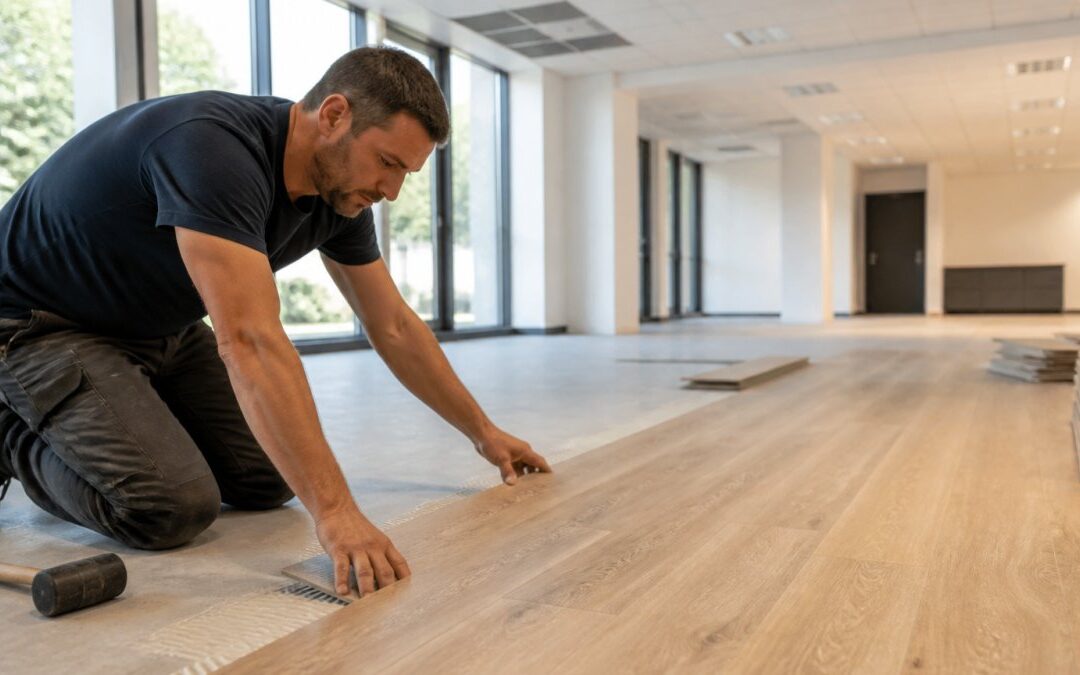
Last Updated: 29 October 2026
Quick Summary
A flooring contractor is a specialist who surveys the site, tests and prepares the subfloor, then supplies and fits the covering, handing back a durable finished surface. Choose one who puts subfloor preparation and moisture testing in writing, prices against a scope you issue, and can show insurance and a method statement.
- Most commercial flooring installations take between one and five days, depending on area, subfloor and material.
- Concrete slabs emit water vapour for years, so moisture testing must be listed as a quote line item.
- Issue the same written scope to every contractor so quotes can be compared line by line.
- Ask for public and employers’ liability insurance plus a site-specific risk assessment and method statement.
- Build screed cure time into your programme before booking the fit, not after.
Table of Contents
- What to Expect From a Commercial Flooring Contractor
- The Commercial Flooring Installation Process, Step by Step
- How Long Does Commercial Flooring Installation Take?
- Preparing an Office for Carpet Tile Installation
- Out-of-Hours Flooring Installation for 24/7 Sites
- How to Compare Flooring Contractor Quotes
- Request a Quote From RW Flooring
- Frequently Asked Questions
What to Expect From a Commercial Flooring Contractor
Choosing the right flooring contractor starts with knowing what a good one actually delivers. A commercial flooring contractor is a specialist who prepares the subfloor, supplies and fits the chosen floor covering, and hands back a finished, durable surface built for daily commercial traffic. At RW Flooring, we fit floors for workplaces, healthcare sites, schools and hospitality venues, and we know where projects most often go wrong.
The difference between a smooth project and a costly one usually comes down to preparation, not the product. A dependable contractor will survey the site, test the subfloor, and tell you what needs fixing before any covering goes down.
Here is what a professional service should include:
- A site survey and moisture testing before work begins
- Subfloor preparation, including screeding where needed
- Fitting of carpet tiles, LVT, vinyl, laminate or hardwood
- Out-of-hours working to protect your operations
- A clear written quotation
What most guides miss is that the subfloor is where corners get cut. If a contractor skips proper surface preparation, the finish will fail early, no matter how good the materials are. Always ask how they plan to prep, and get it in writing.
The Commercial Flooring Installation Process, Step by Step
A structured commercial flooring installation process protects your budget and your timeline. The best contractors follow the same sequence every time: survey, prepare, fit, finish and inspect. Skipping a step is how rework happens. What most guides leave out is the mechanism behind each stage, what is actually being tested, how long it takes, and what happens if it is rushed.
Stage 1: Site Survey and Moisture Testing
The survey is not a sales visit. A competent contractor will measure the area, identify the existing covering and adhesive, check for asbestos-containing materials in older buildings (a legal requirement before disturbance under the Control of Asbestos Regulations 2012), and test the subfloor. Moisture testing is the step most often skipped. Concrete slabs emit water vapour for years, and a covering laid over a damp slab will blister, lift or delaminate regardless of its quality. Moisture is typically measured and compared against the covering manufacturer’s tolerance, which is set by the manufacturer. Ask for the readings in writing and keep them with your project file.
Stage 2: Subfloor Preparation and Screeding
Subfloor preparation is the foundation of any durable finish, and it is where the programme usually stretches. The sequence is: remove the old covering, grind or strip residual adhesive, fill cracks and voids, then level. A cement-based screed needs time to cure before a covering goes down, and the time depends on depth, temperature and ventilation. Moisture-tolerant adhesives can shorten the wait, but they do not remove it. Without this stage, tiles lift, vinyl bubbles and joints open within months. Ask your contractor for moisture readings, the levelling compound specified, and a written method statement before fitting starts.
Stage 3: Fitting and Final Finishes
Fitting is where the visible quality shows. Carpet tiles are laid in a planned pattern, and the choice affects appearance and how many spare tiles you need to keep. LVT and vinyl are cut tight to walls, with a small expansion gap at perimeters covered by skirting or trim. Trims and thresholds are fixed neatly, and door undercuts are checked so the finished floor clears the door leaf. A professional finish means straight lines, secure edges and no gaps at doorways.
Stage 4: Inspection and Handover
A proper handover includes a walk-round, a snag list and care instructions. Ask for the manufacturer’s cleaning and maintenance guidance, using the wrong cleaner on a resilient floor can void its warranty. This is the stage where a good contractor separates from a cheap one: the cheap quote often ends when the last tile is laid.
Build the cure time into your programme before you book the fit. A two-day fitting window with a two-day screed cure is a four-day project, not a two-day one.
How Long Does Commercial Flooring Installation Take?
Most commercial flooring installations take between one and five days, depending on area size, subfloor condition and material. A single office floor of carpet tiles often fits within a day or two, while screeding and drying time can add several days. Healthcare and hospitality sites with complex layouts take longer.
Timeline is where quotes differ most. A cheap quote that ignores drying time will cost you later. We build realistic schedules around screed cure times and access, so the finish lasts.
Preparing an Office for Carpet Tile Installation
Preparing an office for carpet tile installation means clearing furniture, protecting power and data points, and confirming the subfloor is level and dry. Good preparation cuts fitting time and avoids damage to desks, cabling and IT equipment.
Your preparation checklist:
- Book the fit around quiet periods or weekends
- Clear desks and remove loose furniture
- Label and protect power and data floor boxes
- Confirm subfloor moisture readings are within tolerance
- Agree access routes and waste removal
- Confirm who moves heavy items and who protects finishes
Watch out: leaving furniture in place to “save time” often slows the fit and risks damage to new tiles. A short, well-planned shutdown is cheaper than a rushed job.
Out-of-Hours Flooring Installation for 24/7 Sites
Out-of-hours flooring installation lets healthcare, hospitality and 24/7 operations get new floors without closing. Fitters can work evenings, nights and weekends so your site stays open during the day.
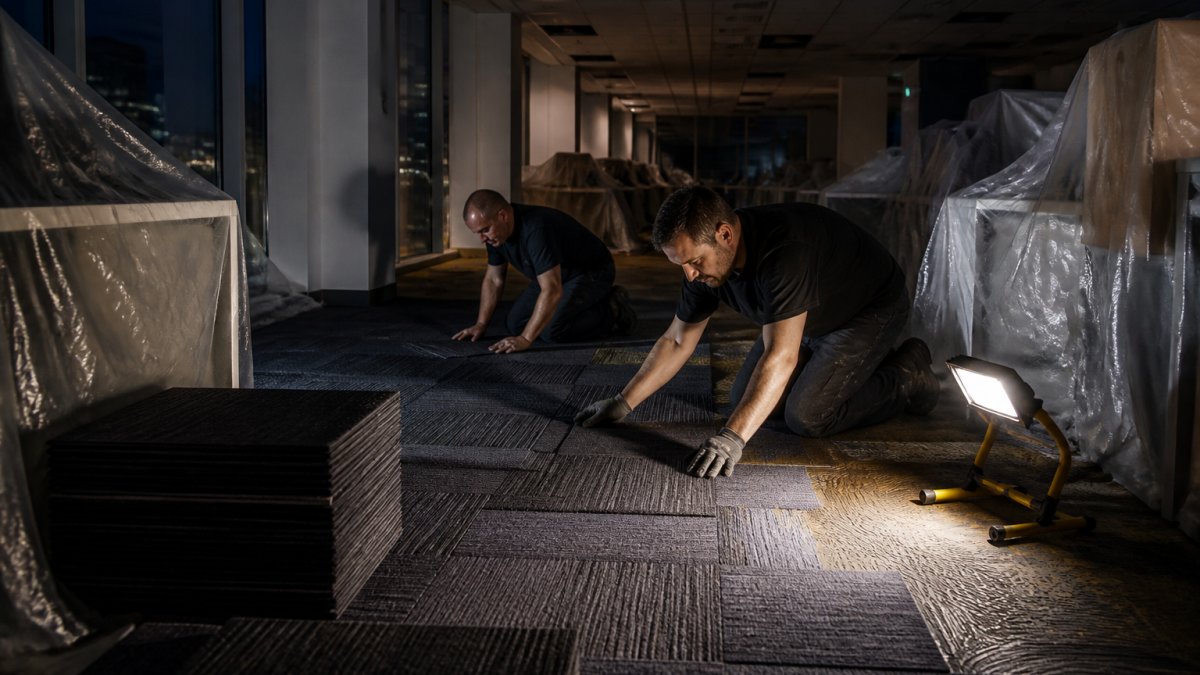
Out-of-hours fitting is available, and we can plan work around your operating hours. Contact us to discuss how it would work for your site.
How to Compare Flooring Contractor Quotes
Comparing flooring contractor quotes means looking past the total price to what is actually included. The cheapest quote often excludes subfloor preparation, screeding, waste removal or out-of-hours labour, so it is not comparable. The unique angle most guides miss: a quote is only comparable if every contractor prices the same scope, and the way to force that is to issue a written scope before anyone quotes.
Issue a Scope Before You Ask for Prices
Write down the area in square metres, the covering you want, the access arrangements, whether the site stays open, and who removes waste. Send the same document to every contractor. Quotes that come back against an identical scope can be compared line by line; quotes that come back against a vague brief cannot.
Read the Quote Line by Line
A fair commercial quote breaks out:
- Subfloor preparation, levelling compound, primer and labour, priced separately from fitting
- Moisture testing, listed as a line item, not assumed
- Fitting labour, usually priced per square metre or as a day rate, with the number of fitters stated
- Materials, covering, adhesive, trims and thresholds, with wastage allowance
- Waste removal, skip hire or a licensed carrier, named
- Out-of-hours premium, night and weekend labour costed explicitly if you need it
If a quote collapses these into one figure, ask for the breakdown. A contractor who cannot break it down cannot defend it.
Spot the Exclusions That Make Quotes Incomparable
| What to Check | Why It Matters | Red Flag |
|---|---|---|
| Subfloor preparation included | Prevents early failure | “Prep extra if needed” |
| Moisture testing listed | Confirms slab is ready | No testing mentioned |
| Out-of-hours labour costed | Protects daytime operations | Daytime-only pricing |
| Waste removal included | Avoids surprise charges | “Skip hire by client” |
| Programme and drying times | Realistic timeline | Unrealistically fast |
| Insurance and safety method | Protects your site | No documentation |
| Wastage allowance stated | Covers cuts and spares | No allowance, no spares |
Check Insurance, Accreditation and Safety Documentation
Ask for evidence of public liability insurance and employers’ liability insurance. For commercial work, check membership of a recognised trade body and ask for a site-specific risk assessment and method statement. A contractor who cannot produce these is a risk to your site, your insurance and your programme.
Weigh Price Against Programme, Not Just Total
A quote that is 10% cheaper but adds three days of cure time may cost more in lost trading than it saves. Compare the total cost of the project, labour, materials, downtime and aftercare, not the headline figure. Pricing depends on quantity, dates and delivery. For current prices or a quote, visit the RW Flooring website.
The best quote is not the lowest number. It is the one you can read line by line, against a scope you wrote, from a contractor who can show you their insurance and method statement.
Request a Quote From RW Flooring
The right contractor is the one who prepares properly, works around your schedule and stands behind the finish. If you are weighing up options, start with the details that matter: subfloor preparation, realistic timelines and out-of-hours working.
You can browse our flooring products and categories before you decide. Explore our flooring ranges to see the materials we fit for commercial spaces.
Frequently Asked Questions
What does a commercial flooring contractor do?
A commercial flooring contractor handles everything from surface preparation to the final finish on business premises. That includes screeding and levelling the subfloor, fitting carpet tiles, LVT, vinyl or laminate, and managing waste removal. Many also carry out repairs, floor sanding and restoration. For facilities managers, the value is a single point of responsibility: one team accountable for the subfloor, the installation and the finish, rather than separate trades blaming each other when something goes wrong.
How do I choose a flooring contractor for a commercial project?
Ask three things. First, can they show completed installations in your sector that are still holding up years later? Second, what is their subfloor preparation method, since poor surface preparation causes most premature failures. Third, can they work around your operating hours? Check customer feedback and confirm they carry the right insurance for commercial sites. A flooring specialist who asks detailed questions about your building before quoting is usually a better sign than one who quotes from a photo.
Can office carpet tiles be replaced without closing the workplace?
Yes, in most cases. Out-of-hours flooring installation is one common route: fitters work evenings, nights or weekends so the space is ready by morning. Both approaches need planning, including where furniture and stock will move to, but a full office shutdown is rarely necessary for a straightforward carpet tile replacement.
How much does commercial flooring installation cost?
Pricing depends on the floor area, the material chosen, the condition of the subfloor and whether work happens out of hours. Screeding or levelling a damaged subfloor adds cost but prevents failures later. Rather than compare headline figures, ask each contractor to itemise surface preparation, fitting, materials and waste removal separately, so you can see what is included. Request a quote from RW Flooring for pricing based on your actual site.
How long does commercial flooring installation take?
The commercial flooring installation timescale depends on area, material and subfloor condition. A single meeting room with sound carpet tiles can be done in a day. Open-plan offices, clinics or school corridors typically run to several days or more, and screeding adds drying time before fitting can start. Out-of-hours working stretches the calendar but protects daytime operations. Ask for a phased schedule with dates, not a single completion estimate.
Every commercial floor carries risk: downtime, rework, or a finish that fails early. RW Flooring removes that risk with over 15 years of experience, complete solutions from subfloor preparation to final installation, and out-of-hours fitting that keeps your site running. Get started with RW Flooring and secure a durable, professional finish with minimal disruption.
