
Last Updated: 25 October 2026
Quick Summary
Commercial flooring should be specified by sector, not by taste: offices need carpet tiles or LVT, healthcare needs vinyl sheet and safety vinyl, and schools need heavy contract vinyl. Every specification starts with four questions covering daily footfall, what shoes bring in, cleaning chemicals and whether hygiene or slip resistance is regulated. Get those wrong and even premium products fail early.
- At RW Flooring we have fitted floors across workplaces, clinics, schools and hospitality venues for over 15 years.
- Floor preparation decides whether a finished floor lasts its warranty period or fails within a year.
- Preparation is the line item clients underestimate, and it determines longevity.
- A single large open-plan office can be completed in a few days, while a multi-room clinic can run considerably longer.
- Agree site access, noise restrictions and waste removal routes early for out-of-hours fitting.
Table of Contents
- Choosing the Right Commercial Flooring for Your Sector
- Why Floor Preparation for Commercial Flooring Decides the Finish
- How Much Does Commercial Flooring Cost?
- Understanding Commercial Flooring Installation Time
- A Step-by-Step Guide to Office Carpet Tile Replacement
- Planning Out-of-Hours Fitting Around Your Operation
- Request a Quote for Your Commercial Flooring Project
- Frequently Asked Questions
Choosing the Right Commercial Flooring for Your Sector
The right commercial flooring is the one that survives your building’s daily traffic, cleaning regime and compliance demands without needing early replacement. At RW Flooring, we have fitted floors across workplaces, clinics, schools and hospitality venues for over 15 years, and the pattern is consistent: sector determines specification, not taste.
A commercial flooring specification starts with four questions: how many people cross it daily, what they bring in on their shoes, what chemicals hit it during cleaning, and whether hygiene or slip resistance is regulated. Get those wrong and even premium products fail early.
Matching Flooring to Offices, Healthcare, Education and Hospitality
Office floors face wheeled chairs, heel traffic and the occasional coffee spill. Carpet tiles and luxury vinyl tile both work; carpet tiles win where acoustics matter, vinyl wins where spills are routine.
Healthcare floors must handle frequent disinfection and meet hygiene expectations set out in NHS infection prevention guidance. Vinyl sheet and safety vinyl dominate because seams trap less dirt than tiles.
Schools need impact resistance and slip performance. Hospitality needs fast turnaround between service periods and finishes that hide scuffs.
| Sector | Typical Specification | Key Priority |
|---|---|---|
| Offices | Carpet tiles or LVT | Acoustics, chair castor wear |
| Healthcare | Vinyl sheet, safety vinyl | Hygiene, seamless cleaning |
| Education | Heavy contract vinyl, carpet tiles | Impact resistance, slip safety |
| Hospitality | LVT, contract vinyl | Fast turnaround, stain resistance |
Best for: sector-specific specification. Skip if: you are specifying purely on appearance.
Why Floor Preparation for Commercial Flooring Decides the Finish
Floor preparation for commercial flooring decides whether the finished floor lasts its warranty period or fails within a year. No flooring product performs on a subfloor that is uneven, damp or contaminated. This is the part most quotes gloss over.
What Proper Subfloor Preparation Involves
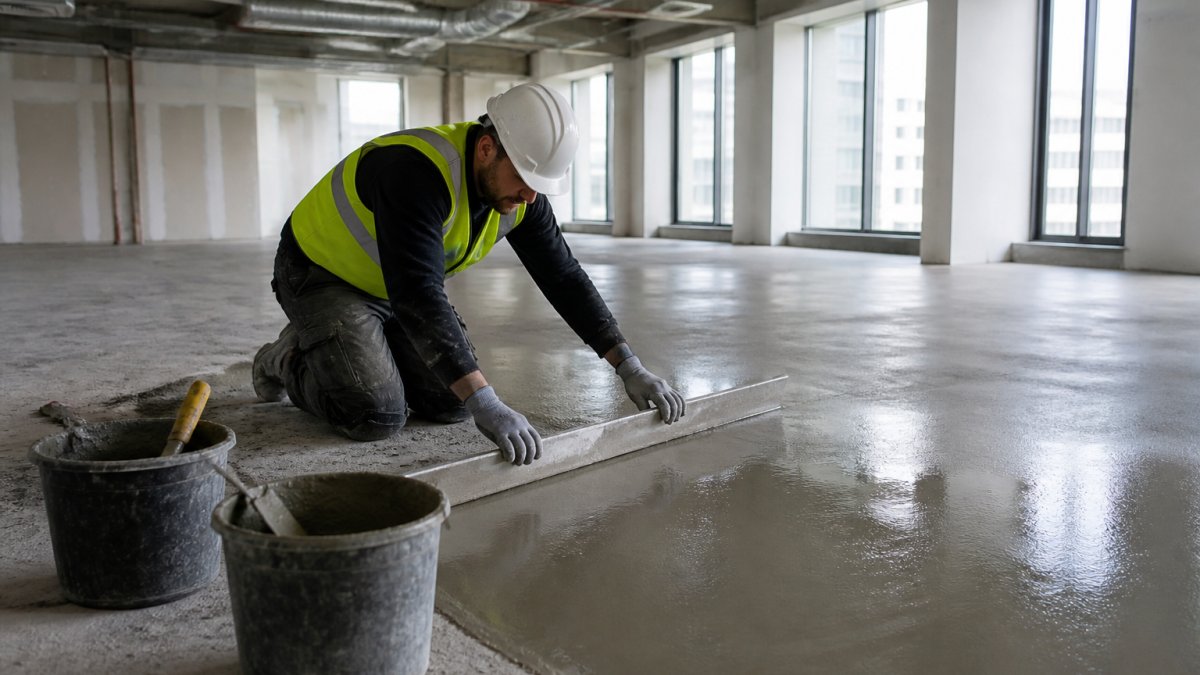
Proper preparation means testing moisture content, checking for contaminants such as old adhesive residue, grinding or planing high spots, filling cracks, and applying a smoothing screed where tolerances demand it. Moisture testing matters most on ground floors and over new concrete.
A common mistake is skipping a moisture test to save a day. The consequence is blistering or debonding months later, and the rework costs far more than the test. Watch out: if a contractor quotes without inspecting the subfloor first, treat that quote as provisional.
How Much Does Commercial Flooring Cost?
There is no single commercial flooring cost figure, because pricing depends on area, product, subfloor condition and access. Anyone quoting a flat rate per square metre without seeing the site is guessing. We price each project after assessing preparation needs and programme.
What drives the number:
- Product type and specification level
- Extent of subfloor preparation required
- Room count, staircases and edge details
- Out-of-hours working and access restrictions
- Uplift and disposal of existing flooring
As a rule, preparation is the line item clients underestimate. It is also the line that determines longevity. For current pricing on our product ranges, browse our flooring products and categories before requesting a quote.
Understanding Commercial Flooring Installation Time
Commercial flooring installation time depends on area, product and preparation, not on the fitting alone. As a working guide, a single large open-plan office can be completed in a few days, while a multi-room clinic with preparation work can run considerably longer. Programme length is set by the slowest constraint, usually subfloor curing.
Screed and adhesive need curing time before the finished floor goes down. Rush that and the installation fails. We build curing windows into the programme rather than discovering them mid-project. For a tighter timeline, phasing the work room by room usually beats compressing the schedule.
A Step-by-Step Guide to Office Carpet Tile Replacement
Office carpet tile replacement follows a predictable sequence, and following it protects both the programme and the finished result. Here is how we run it.
- Survey the floor and test the subfloor
- Agree specification and phased programme
- Remove and dispose of existing carpet
- Prepare the subfloor and allow curing
- Set out tiles and check pattern alignment
- Install tiles, working away from access points
- Fit edge trims and finish thresholds
- Hand over with care guidance
Best for: occupied offices needing minimal downtime. Skip if: the subfloor is failing, in which case preparation comes first.
Planning Out-of-Hours Fitting Around Your Operation
Out-of-hours fitting exists so your operation keeps running. For clinics open around the clock, schools mid-term and restaurants trading nightly, daytime installation is not an option. We programme evening, overnight and weekend shifts around your schedule.
The practical points to agree early: site access and key holding, noise restrictions, waste removal routes, and how much floor must be usable each morning. Safety methods are maintained on every shift, which matters more at night when fewer people are on site.
Request a Quote for Your Commercial Flooring Project
A quote is only useful if it reflects the actual site. We survey first, then price preparation, product and fitting as separate lines so you can see where the money goes. With over 15 years of experience and complete solutions from subfloor preparation to final installation, we deliver dependable project delivery and a professional finish.
Get started with RW Flooring and request a quote for your commercial flooring project today.
Frequently Asked Questions
How long does commercial flooring installation take?
Commercial flooring installation time depends on the area, material and subfloor condition. A single office suite with carpet tiles can often be completed out of hours over a few nights, while larger healthcare or hospitality projects with extensive subfloor preparation take longer. Drying times for screed and adhesive add to the schedule. A contractor should survey the site first and give you a phased programme so you know exactly which areas are out of use and when.
How do you replace office carpet tiles without closing the office?
Office carpet tile replacement can be phased so staff keep working. Contractors lift and replace tiles in sections, usually overnight or at weekends, and use low-odour adhesives where fixing is needed. Because carpet tiles are modular, worn or damaged tiles can be swapped individually rather than replacing a whole floor. Agree the phasing and access arrangements in advance, and confirm how furniture will be moved and reinstated each shift.
What is the best flooring for commercial premises?
There is no single best option. Offices usually suit carpet tiles for acoustic comfort and easy replacement, healthcare settings need smooth, hygienic finishes such as safety vinyl with welded seams, schools benefit from impact-resistant vinyl or rubber, and hospitality often uses hard-wearing luxury vinyl tile or timber-effect finishes. The right choice depends on traffic levels, cleaning regimes, slip risk and how long you need the floor to last.
How much does commercial flooring cost?
Commercial flooring cost varies with the material, the size of the area, access, and how much subfloor preparation is needed. Preparation is often the variable that catches clients out, so ask for it to be itemised separately rather than bundled into a square-metre rate. Request a site survey and a written quote that sets out materials, preparation, out-of-hours labour and waste removal, then compare like for like across tenders.
