
Last Updated: 5 November 2026
Quick Summary
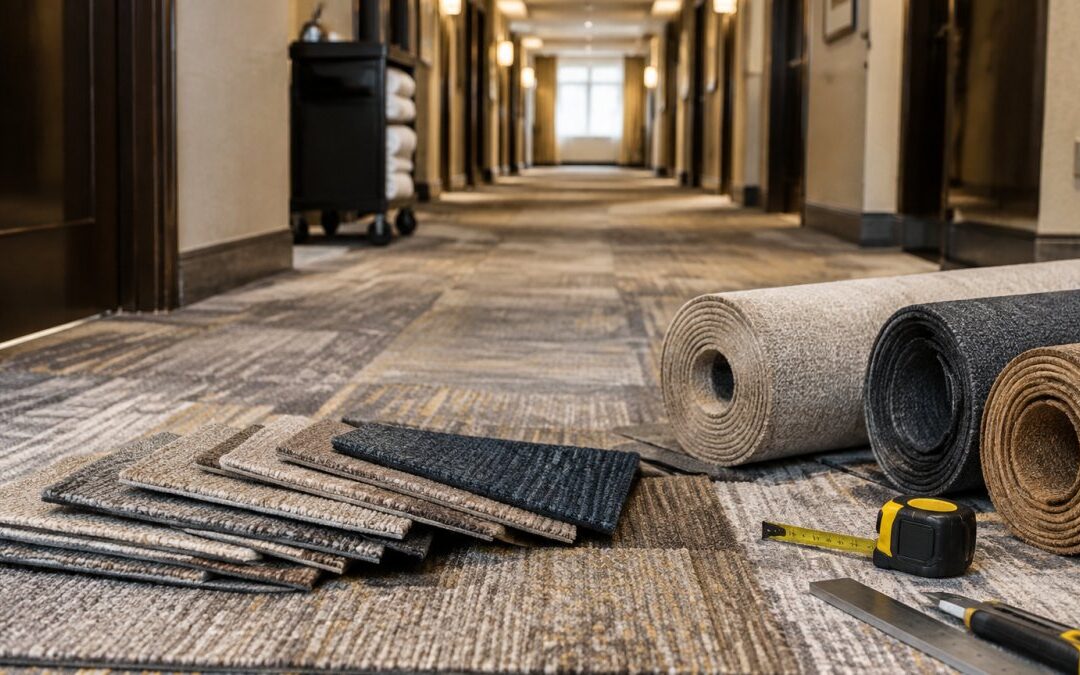
Commercial carpet tiles are the best flooring for hotel corridors on upper guest-room floors, because they absorb impact sound and let damaged sections be replaced without closing a whole run. For ground-floor corridors, lift lobbies and service routes, specify commercial vinyl such as SPC for heavy trolley traffic. Always check slip, fire and hygiene performance, not just the surface.
- Carpet tiles win on acoustics, comfort and repair speed, but cheap tiles with thin wear layers flatten quickly.
- SPC suits heavy trolley traffic while LVT suits design-led areas where comfort matters.
- Textile surfaces absorb impact sound far better than hard floors, which reflect it back into the corridor.
- Over-wet mopping of vinyl and laminate pushes moisture into seams, causing lifting and mould.
- Porcelain tile carries the highest labour cost because of setting times and the need for a rigid, level substrate.
Table of Contents
- Quick Comparison: Flooring Options for Hotel Corridors
- Commercial Carpet Tiles for Hotels: The Acoustic Default
- Commercial Vinyl Flooring for Hotels: Hard-Wearing and Waterproof
- Hotel Corridor Noise Reduction Flooring: What Actually Works
- Slip Resistance, Fire Safety and Hygiene Standards
- Hotel Flooring Maintenance: Cleaning Regimes That Protect Your Investment
- Lifecycle Costs and Environmental Impact Compared
- Sensory and Accessibility Considerations for Neurodivergent Guests
- Frequently Asked Questions
Quick Comparison: Flooring Options for Hotel Corridors
Choosing the best flooring for hotel corridors comes down to balancing noise, safety, maintenance and whole-life cost, and for most hotels the shortlist runs to a handful of proven options. The table below summarises the seven options we assess most often.
| Option | Noise Reduction | Slip Resistance | Maintenance | Best For |
|---|---|---|---|---|
| Commercial carpet tiles | High | Moderate | Vacuum plus periodic deep clean | Upper floors, guest-room corridors |
| Glued broadloom carpet | High | Moderate | Vacuum plus periodic deep clean | Feature corridors, public rooms |
| Commercial vinyl (LVT/SPC) | Low to moderate | Good when specified | Damp mop, polish | Ground floors, high-traffic links |
| Linoleum | Low to moderate | Good | Damp mop, periodic seal | Sustainability-led projects |
| Porcelain tile | Low | Good when textured | Sweep and mop | Lobbies, wet-rated transitions |
| Flocked flooring | Moderate | Good | Vacuum and damp mop | Corridors wanting textile feel with hard-floor upkeep |
| Laminate | Low | Moderate | Dry clean, limited moisture | Cost-conscious large areas |
For the wider selection criteria behind this shortlist, our commercial flooring buyer’s guide for hotels walks through specification, budgets and procurement.
Commercial Carpet Tiles for Hotels: The Acoustic Default
Commercial carpet tiles for hotels remain the default for guest-room corridors because they absorb impact sound and allow damaged sections to be replaced without closing a whole run.
Where Carpet Tiles Win and Where They Fall Short
Carpet tiles win on acoustics, comfort underfoot and repair speed. A stained or damaged tile comes up and a replacement goes down in minutes. Where they fall short is in wet or heavily soiled zones near lifts and service doors, and cheap tiles with a thin wear layer flatten quickly in circulation zones. Specifying a light domestic-grade tile in a high-traffic corridor can lead to rapid pile crush.
Once you have settled on carpet tiles, our guide to hotel flooring suppliers to compare sets out what to check before you buy.
Commercial Vinyl Flooring for Hotels: Hard-Wearing and Waterproof
Commercial vinyl flooring for hotels suits ground-floor corridors, lift lobbies and service routes where spills and trolley traffic are routine. Luxury vinyl is generally suited to areas where moisture is a constant risk.
Luxury Vinyl Tile and SPC Compared
Luxury vinyl tile (LVT) offers a printed design layer over a flexible core, so it feels warmer and quieter underfoot. SPC, or stone polymer composite, uses a rigid core that resists indentation better and tolerates temperature swings. In practice, SPC suits heavy trolley traffic; LVT suits design-led areas where comfort matters. The wear layer is the number that decides lifespan, so specify a commercial grade rather than a domestic one.
Hotel Corridor Noise Reduction Flooring: What Actually Works
Hotel corridor noise reduction flooring works by absorbing impact sound at the source, and textile surfaces do this far better than hard floors.
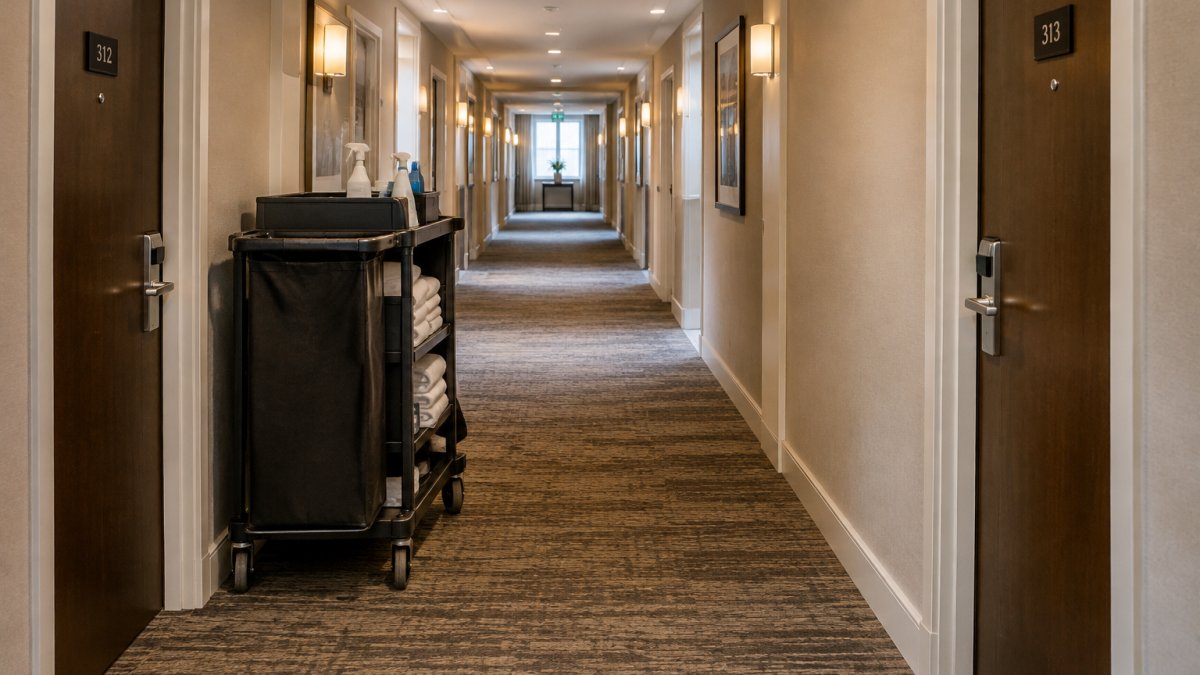
Acoustic performance depends on more than the surface. Underlay, subfloor preparation and how tightly the floor is bonded all affect impact sound reduction. A common mistake is upgrading the carpet but leaving a hollow, uneven subfloor beneath it, which transmits noise regardless of the topping.
Slip Resistance, Fire Safety and Hygiene Standards
Slip resistance, fire safety and hygiene standards decide which floors are legally and practically suitable, not just desirable. In the UK, flooring for commercial premises must meet fire safety requirements and, in kitchens and washrooms, hygiene expectations that resist bacterial growth and allow thorough cleaning.
Slip Resistance Ratings Explained
Safety flooring is rated by slip coefficient, and wet areas such as corridor transitions to bathrooms need a higher rating than dry circulation zones. Slip resistance is typically assessed using recognised test methods, and wet areas generally require a higher rating than dry zones. For a hotel corridor, a dry zone might accept a lower rating, but the threshold to a bathroom or a lift lobby where spills occur should be specified at a higher level. Entrance matting and a dirt barrier at each corridor end stop grit before it reaches the floor finish, which protects both slip performance and the floor itself.
Fire Safety and Reaction to Fire
Fire safety for flooring is governed by the Building Regulations, and reaction-to-fire performance is assessed against the relevant UK standard. Floor fire-performance requirements should be confirmed against the project’s fire strategy and the relevant Building Regulations. The classification considers both the surface spread of flame and smoke production, so a product that performs well on one measure may still be unsuitable if smoke output is high. Always check the manufacturer’s declaration of performance rather than relying on a generic claim.
Hygiene and Infection Control
Hygiene expectations are highest in kitchens, washrooms and service corridors. Floors in these areas should resist bacterial growth, allow thorough cleaning and tolerate the disinfectants used by housekeeping. For wet rooms and bathroom thresholds, our guidance on the best non-slip flooring for hotel bathrooms covers the ratings that matter. If hygiene compliance is the priority, these durable flooring choices for hygienic compliance set out the options against the standards.
Watch out: specifying a floor on slip rating alone without checking its fire classification and hygiene performance can leave a corridor non-compliant even though it feels safe underfoot.
Hotel Flooring Maintenance: Cleaning Regimes That Protect Your Investment
Hotel flooring maintenance is an important factor in how long corridor floors perform, because a sound specification still degrades under the wrong cleaning regime. A workable regime has three layers:
- Daily: vacuum carpet tiles and flocked flooring; dust-mop hard floors to remove grit.
- Weekly: damp mop vinyl and linoleum with a neutral cleaner; spot-treat stains on carpet.
- Periodic: deep-clean carpet, reseal linoleum, and check wear layers at trolley routes.
Watch out: over-wet mopping of vinyl and laminate pushes moisture into seams and edges, causing lifting and mould. Cleaning protocols should match the manufacturer’s guidance, and staff need training on dilution rates.
Protecting the investment over years comes down to who fits and maintains the floor, which is why our commercial flooring contractor selection guide is worth reading before you appoint anyone.
Lifecycle Costs and Environmental Impact Compared
Lifecycle costs and environmental impact rarely appear on the same spreadsheet, yet they decide which corridor floor is genuinely cheapest over ten years. A hard floor costs less to clean day to day but reflects noise and can fail earlier under heavy trolley traffic. Carpet tiles cost more to maintain but allow section replacement, extending the whole floor’s life.
Total Cost of Ownership: Where the Money Actually Goes
A meaningful comparison looks beyond the supply-and-fit price per square metre. The costs that separate a cheap corridor floor from an expensive one accumulate in four places:
- Installation: subfloor preparation, adhesive, trims and access for fitting. Porcelain tile carries the highest labour cost because of setting times and the need for a rigid, level substrate; carpet tiles and LVT are quicker to lay and tolerate more substrate variation.
- Routine cleaning: vacuuming carpet and flocked flooring takes more staff time than dust-mopping a resilient floor, but over-wet mopping of vinyl and laminate causes seam lifting that erodes the saving. Labour rates dominate this line, so a floor that halves cleaning minutes per square metre per day compounds its advantage over a decade.
- Periodic restoration: deep-cleaning carpet, resealing linoleum and polishing vinyl all carry a recurring cost. Carpet tiles win here because a damaged tile is replaced individually rather than triggering a full-run refit.
- Replacement and disposal: the end of life is where budgets are most often underestimated. Carpet can be bulky and difficult to recycle, while some vinyl and linoleum products may be eligible for manufacturer take-back schemes.
The cheapest floor to buy is not always the cheapest to own. A corridor with heavy trolley traffic may favour a floor with a thicker commercial wear layer and section-level repairability, even at a higher upfront price.
Environmental Impact: Embodied Carbon, Indoor Air Quality and Disposal
On environmental impact, linoleum made from natural raw materials and resilient flooring with recycled content score well on embodied carbon, but disposal matters too. Carpet is bulky and difficult to recycle, while vinyl and linoleum can sometimes be returned through manufacturer take-back schemes. Specify low-VOC adhesives and finishes to protect indoor air quality during and after installation, particularly in corridors with limited ventilation where emissions linger.
The end-of-life question deserves more attention than it usually gets. A floor that cannot be recycled or returned cleanly carries a hidden cost that only appears at refurbishment.
Sensory and Accessibility Considerations for Neurodivergent Guests
Sensory and accessibility considerations for neurodivergent guests are the angle most corridor flooring guides skip. Pattern-heavy carpets with strong contrast can be visually busy, and glossy hard floors create glare and echo that some guests find uncomfortable.
A calmer specification uses low-contrast patterns, matt finishes and consistent colour between zones so the corridor reads as one continuous path. Tactile cues at lift lobbies and stair approaches help guests with visual impairments, and a quiet underfoot surface reduces the sharp noise that can cause distress. None of this needs to compromise durability; it simply shifts the design brief toward restraint.
Frequently Asked Questions
What is the best flooring for hotel corridors?
There is no single answer, because hotel corridors combine high foot traffic, trolley wheels and noise transfer into guest rooms. Commercial carpet tiles and commercial vinyl flooring are the two most common choices. Carpet tiles absorb impact sound and are easy to patch, while vinyl handles spills and heavy cleaning better. The right pick depends on your star rating, cleaning capacity and whether noise between rooms is a known complaint.
Is carpet or vinyl better for hotel corridors?
Carpet tiles usually win on acoustics and comfort underfoot, and individual tiles can be replaced when stained. Vinyl, particularly luxury vinyl tile or SPC, wins on moisture resistance, hygiene and ease of mopping. Many hotels use carpet in guest-room corridors and vinyl in lift lobbies, service corridors and breakfast areas where spills are routine. Matching the material to the zone rather than the whole floor is often the most cost-effective approach.
Are carpet tiles suitable for hotel corridors?
Yes, commercial carpet tiles are widely used in hotel corridors because they reduce impact sound, hide tracked-in dirt and allow spot replacement without closing the corridor. Choose a commercial-grade tile with a dense pile and a sturdy backing, and specify a tight installation method so tiles do not lift under trolley traffic. Entrance matting at each lift and stair core will extend the life of the carpet considerably.
What hotel corridor flooring helps reduce noise?
Carpet tiles with an acoustic backing are the most effective at reducing impact sound from footsteps and trolleys. Where a hard floor is required, specify vinyl with an acoustic underlay and seal every perimeter joint, as gaps let sound pass into the room below. Door undercuts and wall junctions mattr as much as the floor itself, so ask your contractor to detail these during the survey rather than after installation.
Which corridor flooring is easiest to maintain?
Commercial vinyl flooring is the simplest to clean day to day: it can be mopped, machine-scrubbed and disinfected without the drying delays that affect carpet. Carpet tiles need regular vacuuming and periodic encapsulation or hot-water extraction, and spills must be treated quickly to avoid permanent staining. Whichever you choose, a written hotel flooring maintenance schedule with daily, weekly and periodic tasks will keep the surface looking presentable for longer.
Corridor flooring that looks right on day one and still performs five years later comes down to specification, subfloor preparation and fitting done properly. RW Flooring brings over 15 years of commercial experience, out-of-hours fitting to keep your hotel running, and complete solutions from subfloor preparation to final installation. Get started with RW Flooring and specify a corridor floor that holds up to daily traffic.
